Tag: search engine optimisation

  • Extend the registration period of your domain name for better SEO

    SEO boost - extend the renewal period of your domain name
    For an SEO boost – extend the renewal period of your domain name

    The website domain name is often overlooked in SEO terms as people focus on inbound links and optimised web copy, however, your domain name – or in this instance the information relating to it – is one of the important criteria used by Google when evaluating your website.

    We all know that new domain registrations are likely to be sand-boxed as Google prefers to err on the side of caution when it comes to a potential pop-up website, however, once your site is established and your domain name is at least a good few months old, Google will begin its ongoing assessment of your website including the information relating to the domain and use it to decide how important your site it.

    Google really ‘likes’ older domain names with long registration periods to go. You can now commonly register the most popular domain names for up-to 10 years. Not only will you save money and not have the hassle of trying to remember when it’s due for renewal, you’ll have the extra SEO benefit of indexing better within the search results!

    If you’re still unsure about why this is important, think about it like this. If I were of a nefarious persuasion with wicked SEO skills, I could very easily set up an eCommerce website, optimise it to get it to the top of the search results and start taking money off people. This is very easy to do and there were, for example, some very high profile cases of this happening, for example, during the most recent Wimbledon tennis tournament.

    This type of site has to be quick – people are going to start complaining pretty quickly when they don’t get what they’ve bought so the site isn’t going to be up for that long when the authorities find out. Therefore, if Google sees a new website with a recently registered domain name and a short registration period, alarm bells will go off! This is why a pre-emptive suppression within the search engine results is the simplest solution to this potential problem. The legitimate sites will register their domains for longer and they’ll still be up and running in a few months. It’s a bit like a website probationary period.

    In summary, if you want your site to be taken seriously by Google and indexed properly, extend the registration period of your domain name.

    If you need help with your domain renewal period, or anything else relating to SEO or search engine optimisation, call us here at Seven Creative on 0114 235 2002 or see the other contact options 
  • Search Engine Optimisation – getting it wrong vs. getting it right

    If you’ve ever paid for search engine optimisation (SEO) or are wondering if it will help your website, you need to read this.

    SEO is certainly a buzz word at the moment but where do you get all the facts – how much should it cost? What results should I expect? How do I tell if it’s working? Am I being ripped off?

    This article will show you how SEO done well will give you great long-term results and how SEO done badly can ruin your website rankings.

    So, what is search engine optimisation?

    SEO is simply the process communicating with Google and the other main search engines to make sure they have a clear understanding of how important your website is, where your target customers are, and what your products & services are.

    Once this is done properly, you’ll appear in search results when your target customers search for the products and services you provide… or at least that’s the theory!

    So, why is this not simple?

    It’s not possible to get an accurate number of how many websites there are currently available but the last estimate put this approaching three quarters of a billion (750,000,000) with the majority of these in English.

    Every one of these sites wants relevant visitors and the search engine’s job is therefore to fetch the appropriate results for you when you do a search based on factors such as where you are, what language you speak, and what you’re looking for.

    The problem is that if Google can’t understand the purpose of your site or doesn’t get a true representation of how important your site is, you won’t appear in the right results.

    So, what is the wrong type of SEO?

    Google is a piece of software, it visits sites using what is known as its ‘Googlebot’ and the measure it uses to evaluate sites is called its algorithm.

    Poor quality SEO companies will tell you that Google assesses a website is by looking at how many other sites link to the website in question– in other words, lots of links to your site = important website – but this only has a very small element of truth in it.

    The reality is that Google is not stupid. Back in the old days of the internet you could get away doing SEO like that but Google continues to become smarter and its algorithm continues to update.

    In fact, you probably heard of the recent infamous Panda and Penguin algorithm updates where sites that had focussed on inbound linking to increase their position in the search engines suddenly dropped out of the rankings overnight – and there were some very high-profile casualties of this!

    So, what is the right type of SEO?

    Getting your SEO right is not rocket science, it just takes a bit more care and attention. Selling someone SEO and then simply creating links to their site is either lazy or unethical (or both!). It may work for a while, however, as soon as you stop paying for this, the results will disappear again… and this is your best case scenario!!! Google is now also penalising sites that use poor quality links so, if your site is important to your business, you’re really taking a huge gamble!

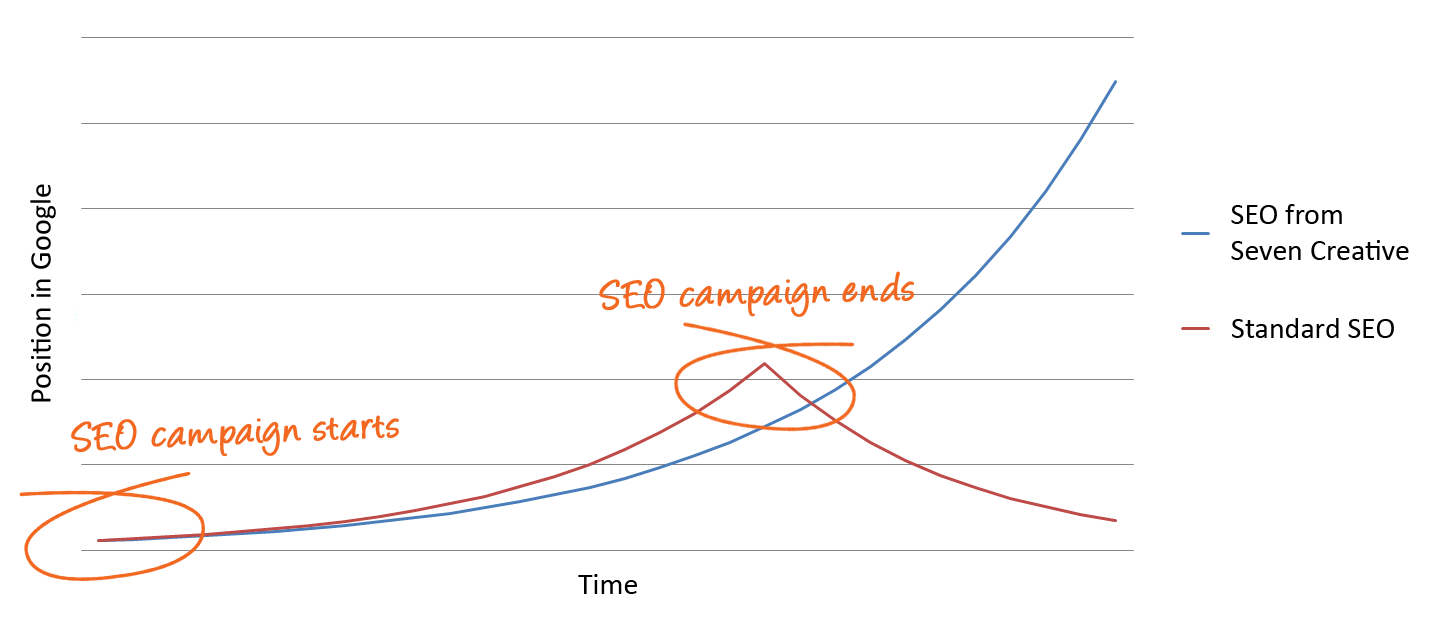
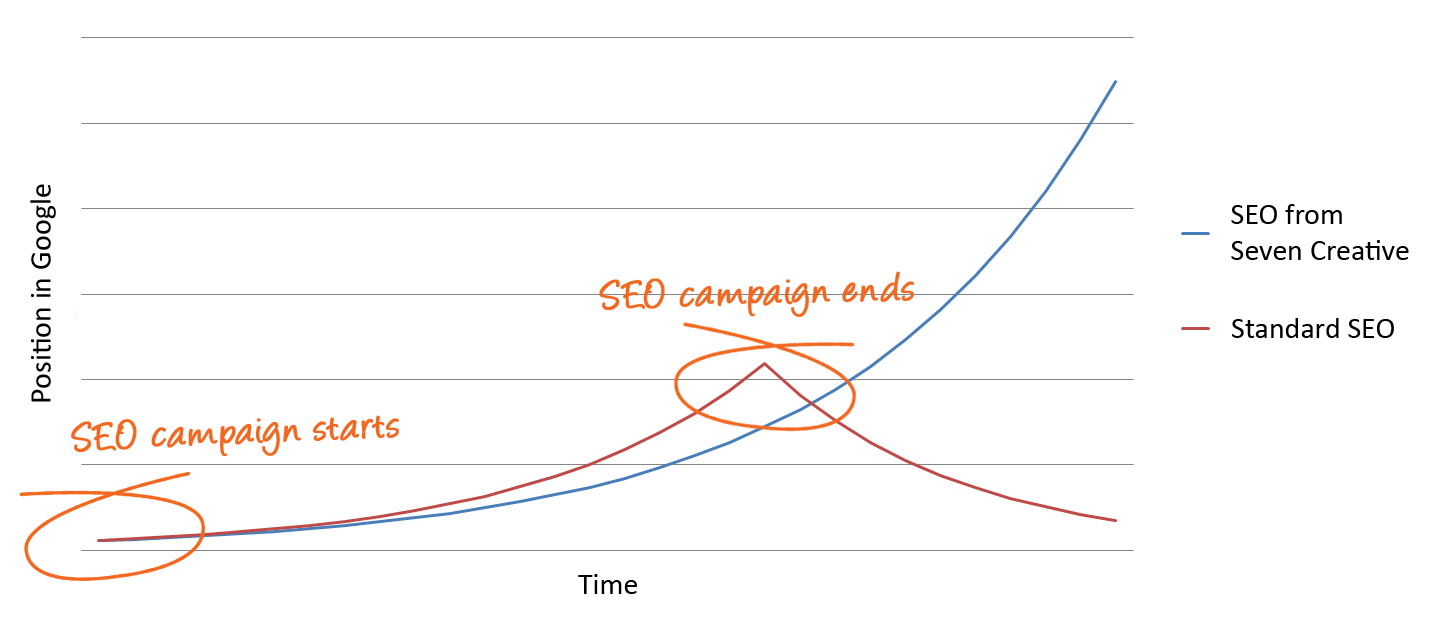
    This graph shows the difference between focussing your SEO on inbound links vs. focussing on good quality content and on-page SEO
    This graph shows the difference between focussing your SEO on inbound links vs. focussing on good quality content and on-page SEO

    I did say, however, that there was an element of truth in using link building as part of your SEO strategy, and there is. Link-building should form at least part of your SEO strategy, but you have to be very careful to make sure that the links pointing to your site are from good quality and relevant websites. Get this right and you’re on your way. Get it wrong and it can be disastrous!

    The best way, however, to do your SEO properly is to do what we here at Seven Creative have always done – focus on high quality content. You’ll see not only an instant boost and an increase in rankings whilst your SEO campaign is in progress, you’ll also see a long-term boost way beyond this. This way, link-building is not something that has to be pro-actively conducted, rather it becomes something that happens organically.

    We (here at Seven Creative) have always said that good quality SEO should primarily focus on ‘quality content’ & ‘on-page SEO’ – and it’s what we’ve always done. Don’t get ripped off, get it done properly.

    Call Seven Creative today on 0114 383 0711 or get in touch through the contact page to see how SEO done properly can benefit your business.

  • R.I.P Adobe Flash Player – August 15th 2012

    Adobe Flash Player meets it's demise
    Adobe Flash Player meets it’s demise

    Not so long ago, the only way to have a half-decent looking animation on a website was using Adobe Flash.

    Movement and interactive images could help sites engage with their customers and it was therefore a useful tool for some sites.

    Because, at Seven Creative, we have always focussed on creating usable and optimised websites without sacrificing anything to ‘floweriness’, we’ve generally always avoided using Flash or, at least, only ever used it where appropriate. We could see the usefulness of the software for some niche sites, however, the negatives always outweighed any potential gains.

    This is why we could see the impending end of Flash when most of the industry was still using this technology.

    One of the main issues with Flash is that it can’t be read by search engines. Sites that are built this way – or even have areas like their navigation in Flash – will not index for these generally highly important site elements. Opportunities are lost as function is sacrificed to form.

    One of our other main bug niggles with Flash is that you can’t edit it in the way that you can easily edit HTML using a WYSIWYG editor which is why it’s not something we would feel comfortable providing to our customers. Technology has evolved and there are newer and better methods for providing the same level of animation and interaction but with easily editable content.

    Roll on a few years and Apple release their range of mobile devices that don’t support Flash. Suddenly, there are a lot of websites that won’t display properly – if at all – on some mobile devices.

    This shook the industry and signalled the beginning of the end.

    Android – Google’s operating system – is released and initially supported Flash, however, they’ve recently said that, from version 4.1, they’ll no longer be supporting this anachronistic technology.  So, from August 15th 2012, any Android device that does not currently have Flash Player installed will never be able to install it.

    There is no doubt that other browsers will also begin to end support for this technology over the next few years.

    Good news for us and our customers but bad news for the hundreds of thousands of websites out there that rely on Flash.

    You might think that we’re still OK at the moment as this currently only really effects mobile devices, however, they already account for a good chunk of the visitors to most websites and this is only set to increase. This is before you get us started on the missed opportunities in search engine optimisation terms!

    If you want our advice, act now. Dumping Flash might not be such a big issue for most sites and may not require a full rebuild.

    If digital marketing is all about spotting and taking opportunities, seeing an opportunity and ignoring it is madness!

  • How to Add Users to your Google Analytics Account

    If you want someone else to be able to view or use your Analytics account then you should carry out the steps below:

    1. Log in to your analytics account at google.com/analytics

    2. Go to your account dashboard or the dashboard for the domain you want to share access to

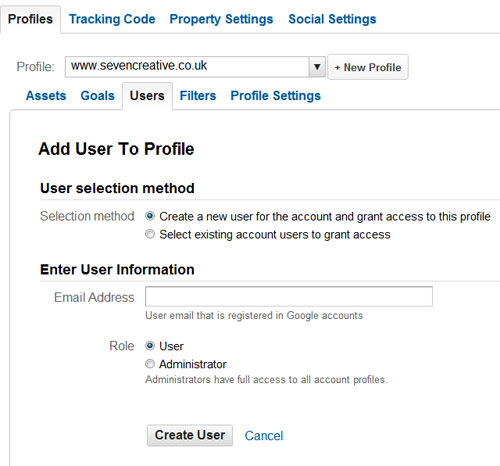
    3. Click on “Admin” at the top right of the screen (see below)


    4. On the next screen, click on “Users” (see below)


    5. On the next screen, click on “+New User” (see below)


    6. Insert an email address (or choose from one you have used previously) and assign them as either a user or administrator, then press “Create User” (see below).


    TA DAH!!

    The added user can now use view your analytics reports

  • We increase visitors to your website. Here’s the proof!


    Here at Seven Creative we believe in doing a good job for our customers.

    One of the things we don’t tend to shout about, however, is our search engine optimisation activity. When we build a site, it wouldn’t really be fair for us to not build in search engine optimisation features, as once you have at least a basic understanding of optimising websites for organic listing, it’s quite quick to do.

    We really enjoy seeing website suddenly rocket in the search engine rankings after we’ve had a bit of a tinker with it. And seeing a rise in website visitors is equally satisfying, as we know then that we’re really having a positive effect on our customers businesses.

    After monitoring the analytics results for some of our recent jobs, and being very happy with the results, we felt it was only right to share these success stories. So here are some of the recent site visitor increases for the websites we’ve been working on:


    Seven Creative Blog – Recent increase in visitors 36.64%

    Clean Sheet Computing – Visitors up by 2,200% (Two thousand, two hundred)log – Recent increase in visitors 36.64%

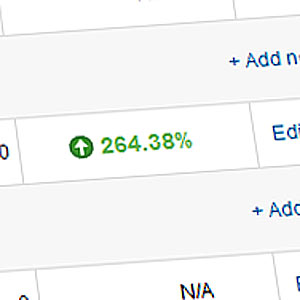
    Dunston Lodge boarding kennels, Chesterfield – Visitors up by 264.38%

    Westgate Cottage, Isle of Wight – Visitors up by 17.65%

    W E G Thomas – Visitors up by 64.71%

    GWB Landscaping, Aylesbury – Visitors up by 89.19%

    Moscar Kennels, Sheffield – Visitors up by 35.07%

    Northshot Photography – Visitors up by 75.66%

    PCT Healthcare – Visitors up by 23.12%

    Seven Creative (our main website) – Visitors up by 22.22%

    HCDL – Visitors up by 33.90%

    So there you have it! Proof that we can increase visitors to your website.

  • Social media: A personal touch in an impersonal world

    Seven Creative’s well established and new customers are recognising the growing importance of social media. We’re proud to say that we can now offer customers new and innovative services ranging from writing blog entries, Twitter posts and Facebook updates, to designing and personalising social networks.

    Ellie Storey, Social Media Manager at Seven Creative,  said “There is so much competition on the digital high street that simply having a website is often not enough. So due to the changing needs of our customers, and demand, we have expanded our services to include a new social networking service.”

    Twitter now boasts an impressive 175 million users, and Facebook has 640 million users across the globe, half of which log on daily. Blogs are increasingly common and websites including Search Engine Optimised text are now a must in order to compete successfully.

    Seven Creative’s principle designer Chris Day said, “Using social networks to increase visibility is something we all need to do these days as the landscape of the internet changes. Social network integration is often difficult to get to grips with and certainly not something most business owners have the time to do properly. That’s where we come in.”

    “We can provide the full spectrum of social networking services to get your business in front of your customers. We are able to assess how your company can benefit from social networking and work with your available budget to help you get the best from it, ” said Chris.

    Social Media: The Benefits

    • Social media allows your customers to immediately give feedback on your products, services and marketing techniques.
    • It provides you with an easily accessible personal relationship with your customers that is designed to make them want to support your company and buy your product.
    • It provides you with advertising and encourages a sense of camaraderie between you and your customer.
    • Social media is a great way for your customers to remember you, your product and your brand. It’s also about customers getting to know other people and a product or service, with product loyalty being an end goal.
  • Sales and marketing optimisation

    Consider the alternatives

    If you were in any doubt that offline advertising spend had fallen in 2009, this physical comparison between the Yellow Pages directories from 2009 and 2010 should convince you. The 2010/11 edition is literally 40% thinner than the 2009/10 edition.

    According to IAB (2010), in the UK, the entire advertising sector contracted by 16.6% in the first half of 2009, however, the online advertising share grew by 4.6% to a record 23.5% share of the market.

    Obviously, in the midst of a recession, you’d expect advertising spend to decline, however, it seems as if many companies are realising that the traditional forms of advertising and marketing may not be the best way to reach customers and deciding rather to look towards the internet.

    Google dominates the pay-per-click (PPC) advertising world with a 65.4% market share (AFP, Feb 2010) and for most people, they’re the only place they’ll ever think of advertising online.

    There is, however, another way!

    The primary objective, when deciding your marketing approach, will be to give you the best return-on-investment (a.k.a. ROI) which, to put it another way, basically means get the most customers for the least spend.

    Google advertising is great for some businesses, but for others, it’ll never work – potential customers simply don’t use the internet to find some kinds of suppliers. Even for the businesses where it potentially works well, so much money is sometimes wasted through poorly researched and implemented key-phrases and badly-planned campaigns that they never reach their potential. Besides this, as the main player in the PPC world, competition for key words and phrases can be fierce!

    Social network advertising, on the other hand, has shown some fantastic results with campaigns we’ve run recently. One of the main problems with Google PPC  is you are only able to target customers geographically. Social Network Marketing, on the other hand, allows you to also target customers demographically and psychographically!  As a relatively new avenue, the current costs can be much lower than Google PPC and you have the option to also pay by impression if you’d prefer.

    Search Engine Optimisation (SEO) as another way to boost your organic search engine rakings. Whereas the results can sometimes be much less tangible than the PPC campaigns; a well optimised web site can give a much better ROI over time.

    If you’re certain that traditional Search Engine PPC is the one for you, consider Bing, Microsoft’s search engine competitor to Google and Yahoo. Bing is currently gaining search engine market share from Google and Yahoo remains a force in the market.

    Whichever you choose, as ever, the key to getting it right is good planning.

    More information

    With many years experience of online and offline advertising campaign planning, setup and management, Seven Creative are perfectly placed to help your business get the best ROI by optimising your sales and marketing activity

    If you’d like Seven creative to help you with your marketing strategy, give us a call on 0114 383 0711 (international: +44  114 383 0711) or contact us through the website