5 reasons why it might be time to update your website content
How long is it since the text on your website was updated? Have you been meaning to rewrite it for ages, but it keeps getting put to the bottom of the to-do list as more urgent work presses on your time? This is a common story for many website owners, however, it might actually be a good time to get your website content updated. Here’s why:
1. Search engines love fresh content
Google loves lots of recently updated content. Websites that regularly add new, unique content are often seen by search engines as more important, and more relevant to web users. That means, if you keep your website up to date, you should naturally rank higher in the search engines than a site whose content remains the same, or hasn’t been updated for quite a while.
It’s also worth checking that your website copy includes the words and phrases that you would like to be found online for. Search engine optimised copy means that your website will be more likely to be found by search engine users when they search for a product or service that you offer, meaning more visitors to your site.
Does your website have a news section? If so, when was it last updated? Adding and regularly updating a News page is a great way of keeping your website up to date with fresh content that search engines and potential customers will love.
There’s nothing worse than checking out a company’s news page only to find that it hasn’t been updated for 6 months. Are they not very busy? Have they gone out of business? You might not think that your company has anything to shout about, but there are lots of things you could write a short article on. For example, a new product, a new member of staff, a great testimonial, or even industry news.
3. Visitors trust up-to-date sites
Regular, loyal customers who see you as a reliable and trustworthy business may be fairly familiar with your site. Why not give them something new to read when they next visit? Adding fresh material to your site on a regular basis means they will keep coming back to see what’s new!
4. Your content is out-of-date or not accurate
So your website copy has been the same since your site went live 3 years ago. If this rings true, you need to act, and fast. Businesses naturally progress and grow, and your website needs to reflect this. The chances are, you’ve developed your services, expanded your product range or gained the experience to specialise in a particular area. And it’s not just your business that may have developed, changes in your industry are inevitable, and keeping up to date with them is key to establishing trust between you and your customers.
5. The contents is boring or not engaging
Even the most brilliant content can become stale over time. The attention of online readers is incredibly short, you literally have a few seconds to grab them and make them want to keep reading. Your website copy may describe exactly what you do accurately, but is it lively enough to capture the attention of a reader and to keep them there?
Content needs to be concise and captivating, getting to the point quickly, and providing the option for readers to find out more. Text should be in bite sized sections, making it easy to scan and process the information with little effort. Text heavy paragraphs that aren’t broken up by images or bullet points are a real put off too!
I still don’t have time to update my website content!
Getting an agency to refresh and rewrite website contents may be more affordable than you think. We’re based in Sheffield and are very experienced in writing copy for websites. We also specialise in SEO and SEO copywriting which is a very important consideration when updating your site. If you’ve been meaning to update your website copy but never quite got round to it, we can help.
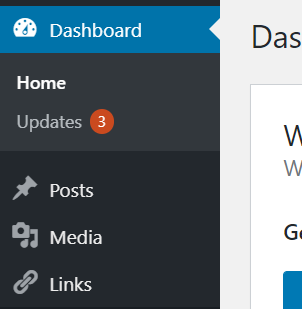
If like me you’ve been using WordPress since the beginning – or at least prior to December 2012, you might remember the old WordPress Links Manager (sometimes also known as Blogroll). However, this functionality was removed by default from WordPress version 3.5 onward. Yes, on the one-hand, links like that are a bit old-fashioned, however, there are occasions when it does come in very useful.
The links manager will allow you to easily create and manage links on your site that are (normally) simply added to the sidebar using a widget.
This functionality is still available within he core WordPress functionality, it’s just turned off now. However, it is pretty easy to ‘turn it back on again’, and here’s how.
How to re-activate or add the WordPress Links Manager to your site
Firstly, you need to access your theme ‘functions.php’ file. The easiest way to do this is through the site’s in-built ‘theme editor’. Find this file for your current live WordPress theme and open the file for editing. If this ‘theme edit’ option isn’t available, try accessing the file via FTP (it’s in the theme files)
Secondly, add the following line of code to the file and save:
10 signs there might be a problem with your website
You’ve got a successful business, you’ve got a website, but is your site bringing in as much business as it could? Here are 10 signs to look out for that mean there may be a problem!
Please note; I’m using Google here when referring to a search engine as it’s the largest and therefore the one we generally focus on when optimising for the web.
1 – You’re not getting many visitors to your site
It’s often difficult to gauge how many visitors you should be getting to your website for many reasons – maybe your products or services are very niche, or maybe the majority
The first thing you need to do is identify your keywords and phrases – the things your target customers will be typing into Google when they’re looking for your products and services. This isn’t always as black & white as you’d imagine, however, with a bit of time you can usually get a good comprehensive list of these phrases. Don’t forget to also get an idea of the average search volumes.
Now you need to see where you appear in Google when you search for these phrases. If you appear as the first result on page one of Google, you should be getting around 30% of the clicks, for example, if 10000 people per month search for the key phrase you’re at position 1 for, you should be getting in the region of 10 visits a day for that phrase (i.e. ((10000/30)*0.3)).
Get your site’s SEO analysed ASAP
2 – You’ve got a high bounce rate
Many websites get the traffic but that traffic is not properly qualified through Google so they immediately leave the site without clicking internally – otherwise known as a bounce.
It’s very important to monitor your keyword density to make sure Google is getting an accurate picture of your products and services. Many people neglect the search engine in favour of the site visitor and often end up with a site that has high usability but poor search engine optimisation. The trick is to take account of both!
If your bounce rate is higher that 40 to 50%, it’s time to look at your search engine optimisation, conversion rate optimisation and usability ASAP
3 – Your phone isn’t ringing
The job of a website is varied and depends on the business. For many it’s to help establish credibility as a supportive sales tool, however, if your site should be generating leads for you and it’s not, we need to find out why!
Usability testing sounds expensive but can actually be very simple to do. For many business owners, they spend so much time within their industry that they forget that the jargon and acronyms they use in their day-to-day lives might not be understood by everyone else! Get someone who knows nothing about your industry to go through your website. Give them a task and get them to tell you when they hit a dead-end, get frustrated, get confused or even give up in exasperation – you may be very surprised at the results! Are your contact forms working? Are your contact details easy to find? Does your site work on all browsers? These are just a few of the things that make the difference between an enquiry and an exit.
Visitors arriving at your site combined with a low bounce rate but no phone calls means there could be a problem with your calls to action, conversion rate optimisation and usability.
4 – You can’t find your site in Google
It might sound obvious but have you searched for your site within Google? Even if it was once there doesn’t necessarily mean it will still be there now!
As Google’s algorithm get’s cleverer, any mistakes that may have been made may suddenly become evident and your site may be being penalised. For example, if you’ve traditionally paid for the type of SEO that has relied on inbound links, you may have recently disappeared from the rankings due to Google penalisation! Even if your site is still there, it may mean that your results are being suppressed!
Not being able to easily find your site from a Google search you should get your SEO looked at ASAP
5 – Exits from contact form but no enquiries
You’re getting the visitors, you’ve got a low bounce rate but you’re not getting the enquiries. Have you tested your contact form? Are your contact details correct? Does your form work? Does your page work on the main web and mobile browsers?
Another one that sounds simple but you’d be amazed how few people actually spend a few minutes each month testing the functionality of their websites.
Send yourself a test message and try the number otherwise it could mean there is a problem!
6 – High percentage of visitors from abroad
There is a lot of information within a website that most people would never even give a second thought to. For example, how does Google know your site is UK English? Maybe it is American English or Australian! I suppose it could look at your server location or domain name and hazard a guess, however, don’t forget that Googlebot is just a piece of software that only has a very short amount of time to assess and categorise your site!
Unless the hidden information within your site is included and correct, your site may not be optimised for its target geographical location and therefore may not be appearing in the right country. It’s important to get this checked and corrected if necessary.
7 – Getting enquiries for products or services you don’t provide
This one seems quite simple on the surface but is actually quite complex. A good website will not only index well within Google for the correct search terms and turn the visitors into enquiries, it should also help your site visitors to properly qualify themselves – or in other words, help them to decide if this is the site they need.
If you bore your visitors with difficult to read text and fail to tell them what you do in a simple, concise and fast manner, the majority of them are going to do one of two things – leave or contact you to ask you what you do – Will you paint my kitchen? No, we only sell paint! What are your opening hours? No, we don’t have a shop! You end up doing what your site could be doing – letting people know if you’re what they’re looking for!
Getting enquiries for products or services you don’t provide means you should test your site’s usability.
8 – Slow loading times
When was the last time you checked to see how quickly your site loads? Clear your cache and give it a go. Googlebot only spends a short time visiting your site and if a proportion of that time is spent waiting for your site to load, it’s not going to be indexing properly.
Another one of the most common problems is badly optimised images. Simply specifying a width to resize an image is a terrible idea! Whether it’s laziness or inexperience, it will still cost you heavily in terms of Google ranking, bandwidth and usability!
Check your bandwidth usage against your visitor numbers and see if they tally. Make sure your images are optimised and that your server is in the UK.
Slow site loading times mean you should have your hosting and site optimisation checked.
9 – Site not displaying properly on mobile devices
Even if you don’t know the statistics you can probably guess that the number of people using mobile devices to access the web has recently exploded and is only set to increase!
Even here at Seven Creative we use Android’s browser; Chrome for Android; Safari for iPad and iPhone; Silk for Kindle; and this is just us!
It can be costly to optimise a site for mobile – especially when it comes to cross browser compatibility – however, there are a few simple things to look out for!
Check your visitor statistics and see what browsers they’re using. Test your site on yours and your friends’ mobile devices. If your site uses Flash, oh dear… time for a new one! If you do find an issue, it might only be a small job to update your site’s CSS to accommodate the new mobile browsers.
There is also talk that Google may be about to start penalising sites that have a bad or absent mobile version so now is the time to act!
10 – Your site looks tired and out-of-date
Just as in person, you only get a very short time to make a good impression. When was the last time you updated your site? Does it look old or outdated? Are your images poor quality? If the answer to any of those questions is yes, then that is the image of your business you are projecting. Of course, if that visitor met you in real life you’d impress them with your wealth of experience and industry knowledge, but the bad news is you’ll never get that opportunity. The visitor will hit ‘back’ and click on the next link – your competitor.
Help is at hand!
If you would like help with any of the potential website problems listed here, get in touch with us on 0114 383 0711 or contact us through out contact page



 If like me you’ve been using WordPress since the beginning – or at least prior to December 2012, you might remember the old WordPress Links Manager (sometimes also known as Blogroll). However, this functionality was removed by default from WordPress version 3.5 onward. Yes, on the one-hand, links like that are a bit old-fashioned, however, there are occasions when it does come in very useful.