5 reasons why it might be time to update your website content
How long is it since the text on your website was updated? Have you been meaning to rewrite it for ages, but it keeps getting put to the bottom of the to-do list as more urgent work presses on your time? This is a common story for many website owners, however, it might actually be a good time to get your website content updated. Here’s why:
1. Search engines love fresh content
Google loves lots of recently updated content. Websites that regularly add new, unique content are often seen by search engines as more important, and more relevant to web users. That means, if you keep your website up to date, you should naturally rank higher in the search engines than a site whose content remains the same, or hasn’t been updated for quite a while.
It’s also worth checking that your website copy includes the words and phrases that you would like to be found online for. Search engine optimised copy means that your website will be more likely to be found by search engine users when they search for a product or service that you offer, meaning more visitors to your site.
Does your website have a news section? If so, when was it last updated? Adding and regularly updating a News page is a great way of keeping your website up to date with fresh content that search engines and potential customers will love.
There’s nothing worse than checking out a company’s news page only to find that it hasn’t been updated for 6 months. Are they not very busy? Have they gone out of business? You might not think that your company has anything to shout about, but there are lots of things you could write a short article on. For example, a new product, a new member of staff, a great testimonial, or even industry news.
3. Visitors trust up-to-date sites
Regular, loyal customers who see you as a reliable and trustworthy business may be fairly familiar with your site. Why not give them something new to read when they next visit? Adding fresh material to your site on a regular basis means they will keep coming back to see what’s new!
4. Your content is out-of-date or not accurate
So your website copy has been the same since your site went live 3 years ago. If this rings true, you need to act, and fast. Businesses naturally progress and grow, and your website needs to reflect this. The chances are, you’ve developed your services, expanded your product range or gained the experience to specialise in a particular area. And it’s not just your business that may have developed, changes in your industry are inevitable, and keeping up to date with them is key to establishing trust between you and your customers.
5. The contents is boring or not engaging
Even the most brilliant content can become stale over time. The attention of online readers is incredibly short, you literally have a few seconds to grab them and make them want to keep reading. Your website copy may describe exactly what you do accurately, but is it lively enough to capture the attention of a reader and to keep them there?
Content needs to be concise and captivating, getting to the point quickly, and providing the option for readers to find out more. Text should be in bite sized sections, making it easy to scan and process the information with little effort. Text heavy paragraphs that aren’t broken up by images or bullet points are a real put off too!
I still don’t have time to update my website content!
Getting an agency to refresh and rewrite website contents may be more affordable than you think. We’re based in Sheffield and are very experienced in writing copy for websites. We also specialise in SEO and SEO copywriting which is a very important consideration when updating your site. If you’ve been meaning to update your website copy but never quite got round to it, we can help.
If you’ve ever looked into search engine optimisation (aka SEO) in any detail you’ll probably have come across what’s known as a ‘sitemap’. And if you are new to SEO, you’ll also probably be asking yourself ‘what is a sitemap’? A sitemap, in its simplest form, is a file (or files) that provide information about files and pages on your website. It normally site with your other files but it used by search engines to more easily & quickly discover the content on your site. It’s normally simply called something along the lines of ‘sitemap’ and will also normally have an ‘.XML’ extension – e.g. ‘sitemap.xml’. Sitemaps are read by search engines and this information is used to get a clearer picture of things like which pages & files there are on a website; and what type of pages & files theses are (for example, contact pages, downloads, or blog posts)
A sitemap is designed to help your site communicate with Google and the other search engines by providing detailed information about your sites pages and contents
What is a sitemap and why does my website need one?
Your main website navigation is how your website visitors find their way around your website, however, these links may not always provide the whole picture to visitors. For example, there may be pages that aren’t particularly relevant to a visitor so they may not be shown these. However, the website owner may actually want all the website pages to appear in Google (as this is an important source of website traffic for many sites) so a sitemap is a fast way of letting the search engine know things such as the following:
Which pages & files exist on a website
When each page was last updated
How often the page is updated
Alternate language versions of the individual page
For video, how long the video is, what is the appropriate age rating, what is the video category
For images, what is the image of, what type of image it is, and what is the image licence
Having a sitemaps is particularly important for:
Sites that contain pages or areas that are not available through the site navigation
Sites that use technologies such as Ajax, Silverlight, or Flash which can’t be ready easily by search engines
Sites that are very large meaning web crawlers may miss some of the new or recently updated content
Sites that have a lot of pages that are isolated or not well linked together
Sites that have few external links for example, new websites)
What does a sitemap look like?
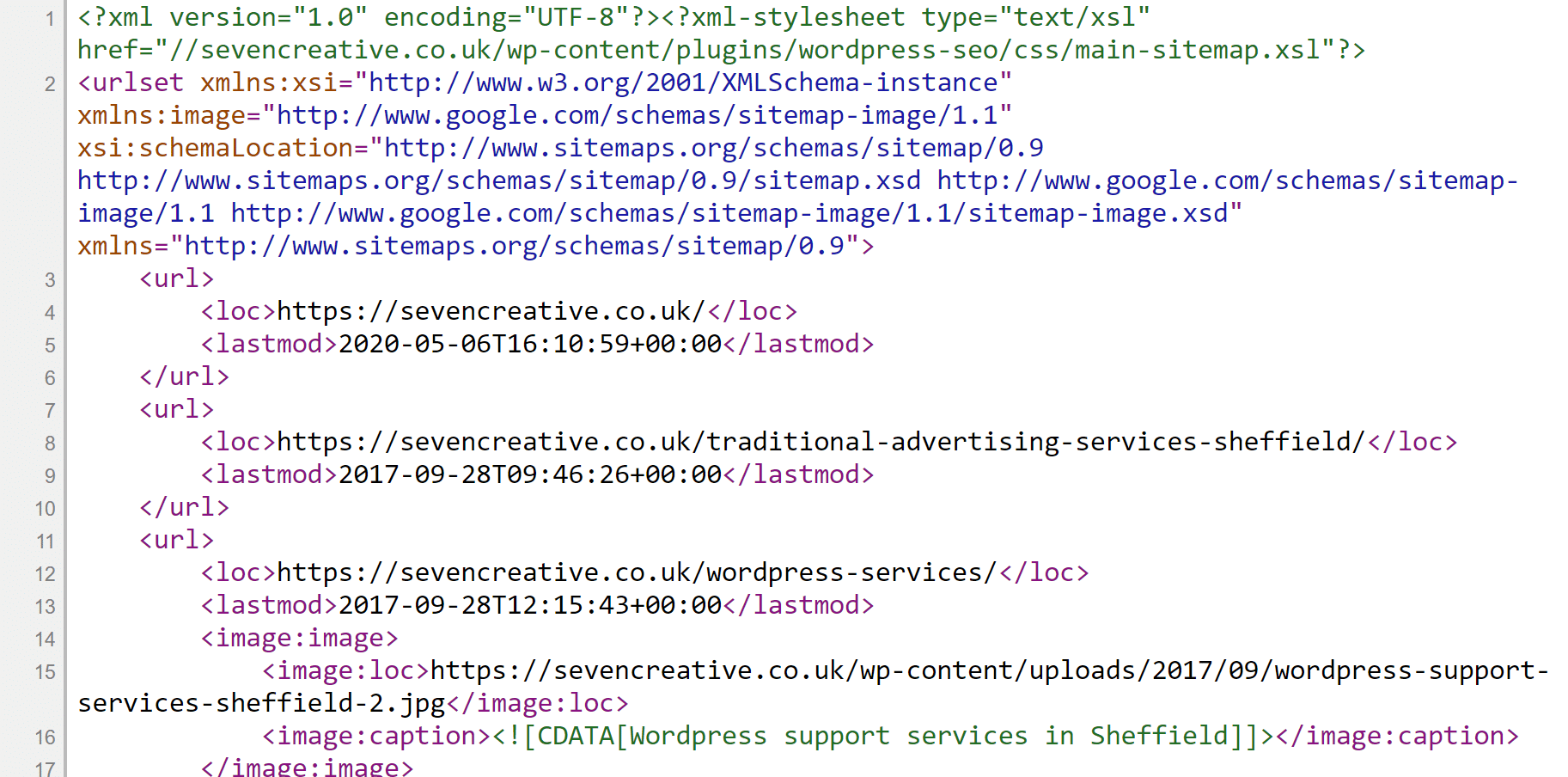
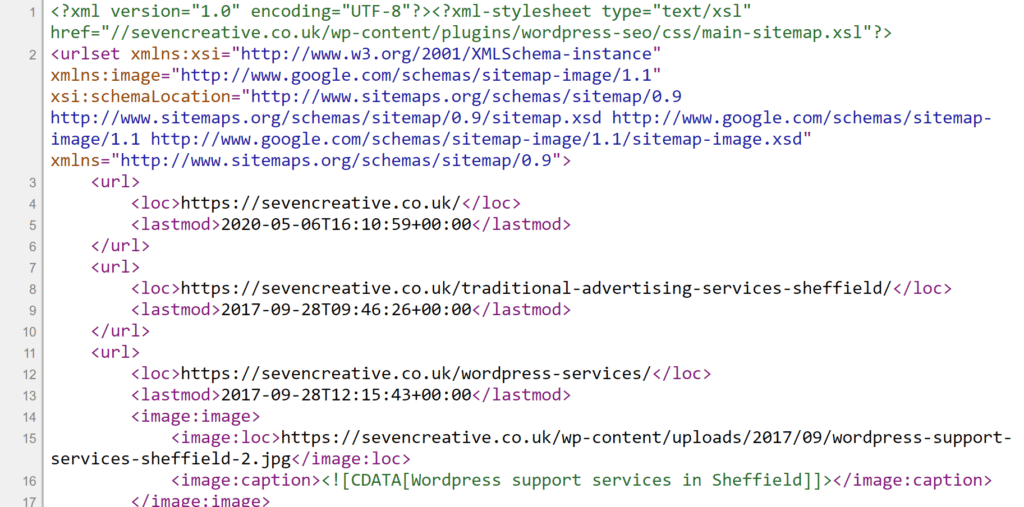
Sitemaps for newer websites are often dynamically generated so change when new content is added. They use the XML mark-up which is like HTML but don’t have any styling information attached. Looking at the raw file may be confusing, but an XML viewer will show you the file in a more user-friendly format. Some internet browsers have an in-built XML viewer. Here is are the sitemaps for this website:
This particular site is quite big which hundreds of blog posts, articles, images and pages so the sitemap structure is quite big
Website sitemaps are a very established part of a website structure (having been introduced in 2005) and continue to be important for search engine optimisation purposes. If you want your site to index properly within search engines, then making sure your sitemap is up-to-date and working correctly a very important part of your activity
Is my website’s sitemap up-to-date?
There are several ways to find out if your sitemap is up-to-date – some fast and some a bit more fiddly and slow. Some sites may not even have a sitemap which may be a problem from an SEO perspective. The best way to find out for certain is by asking an SEO expert to have a look.
If you’re looking for an SEO expert or an SEO company in Sheffield for help with your website and its search engine optimisation (SEO), please give us a call on 0114 383 0711 or visit our contact section
Search engine optimisation (or SEO as it’s more commonly known as) has many definitions but I prefer to describe it as the practice of improving your visibility in search engines for relevant search terms. Better visibility can be called higher rankings (or closer to page 1, result 1) and relevant search terms are words or phrase directly connected to the purpose of a website. Incidentally, Google describes SEO as ‘the process of making your site better for search engines’. The noun ‘SEO’ is used to describe someone like me who makes a living improving the search position of websites e.g. ‘I need to hire an SEO to get my site ranking’. It’s also quite common to use SEO as a verb e.g. to SEO a website or page.
This guide will focus on Google as they’re by far the largest search engine.
1. Check your site is on Google
Do a Google search for ‘site:’ followed by your website URL, for example, to find out if the website sevencreative.co.uk is on Google, search ‘site:sevencreative.co.uk’ (click here to see the results)
If your site isn’t there, it’s probably due to one of the following reasons:
You don’t have any indexed links to your site
Your site is very new
Your site (or server) either blocks Google from indexing it or the search engine simply can’t read your site
Google has blocked your site from the search results (there could be lots of reasons for this)
If you’re not sure why your site isn’t on Google when you think it should be, it might be time to call an SEO expert. Get in touch with us on 0114 383 0711
2. Making your website content good for visitors makes it good for Google
“Make your site interesting and useful” – Google
Your website text and images need to be clear and relevant, and the titles and higher-up-the-page content is more important than the stuff lower down the page. For example, if the title of the page was simply ‘welcome’, it wouldn’t provide any real value to your visitors, it doesn’t mean anything out of context, and it probably has very little to do with the purpose of your site. Let visitors know what your site does quickly and efficiently in all titles and text with relevant narrative images. The title of this page is ‘The do-it-yourself guide to the basics of SEO’ and it’s a page about the basics of SEO. You know what the page is straight away and so does Google.
When I explain to someone how to write a page I tell them there are three types of visitors you’ll get – those who skim the page quickly looking for the words and phrases they hope to see, those who will take the time to read every single word, and those who use are more included to use pictures to understand what a website page is about. Get the purpose of the site in the headings, explain the purpose well in the other content, and explain the site well with illustrative and relevant images. You need to cater for all these three people. In doing that you’ll also be catering for Google.
Pro tips: Aim for at least 300 words per page if you can and be sure to give all your images ‘alt’ descriptions to explain to Google and those using screen readers what they are about.
3. Make use of the ‘description’ meta tag – this explains to Google what the page is about
This information is not displayed as part of your web-page but it used by Google to understand and display what your page is about.
4. Optimise your images
This is surprisingly important from an SEO perspective. Crop, size and compress your images to load quickly on your website. If you don’t have Photoshop try GIMP – it’s a free image editor
5. Make your site mobile-friendly
For many sites these days, most of their visits are by people using their smartphones. If your site isn’t able to be read and used properly by people using smart phones, your site may be penalised by Google
6. Use your Google My Business page
Yes, Google use this as a signal about whether your site is legitimate or not. Improve their content and they’ll improve your rankings.
7. Make sure you have a sitemap and submit it to Google
A sitemap is an index of all the pages on your site you’d like Google to visit (and also sometimes those pages and directories you’d order not be included in the search results). This is very important as it allows Google to know about pages that it might not necessarily find very easily.
Sitemaps are commonly in XML format which is a simple but formal way of listing repetitive information in a file that allows the search engines to read it. Sitemaps are commonly in the same directory as the site’s index file and are normally simply called something along the lines of ‘sitemap.xml’. The main sitemap for this site is located here: https://staging.sevencreative.co.uk/sitemap_index.xml
Not all sites automatically have a sitemap – sometimes you need to create one yourself and upload it to your site. If you’re using WordPress there are several plugins that will do this for you like Yoast or Google XML Sitemaps.
8. Make sure you have an up-to-date and functioning robots.txt file.
A “robots.txt” file tells search engines which files and folders it would like it to be able to access and asks it to not access others. Whether or not the search engine follows these requests, however, is a different thing. Google, however, does use the Robots.txt file and is therefore very important to get your site indexing properly. This file, which must be named “robots.txt”, is placed in the root directory of your site.
Do you need a head start with your SEO?
Give us a call here at Seven Creative if you need a head-start with your SEO. Whatever the age or subject of your site we can improve its position in the search results. Call us on 0114 383 0711 or use our contact form
I’ve been working with websites since before search engine optimisation (SEO) was a ‘thing’. I originally taught myself HTML as a young teenager using a book I found lying about by Carol Vordernman and the rest, as they say, for me at least, is history. I’ve been providing SEO in Sheffield & further afield now for many years. The first of the more sophisticated search engines to start ‘crawling’ the web and using ‘back-links’ to help evaluate a website was BackRub (later Google) back in 1996. It ranked pages using citation notation, meaning any mention of a website on another site would count it as a kind of vote toward the site it pointed to. In other words, basic things like how many links and the quality of those links to a site would improve its ranking and thus the search engine optimisation industry was born.
Sheffield SEO (Search Engine optimisation)
It was very easy to manipulate search engines in the early days
Back in those early halcyon days, the world wide web was not widely understood and search engines were very easy to manipulate. As businesses began to see the potential of the internet, ‘experts’ appeared who promised to get them ‘up the rankings’. It was actually very easy to do using techniques such as keyword stuffing (for example, a hundred instances of a phrase, right at the bottom of a website, in white writing and on a white background or hiding keywords in the source code) and it actually worked! This, in conjunction with very little search engine competition, created a very profitable business for many SEOs. However, this situation meant that a poor quality site could often easily rank better than a good quality sites – and Google certainly didn’t like being manipulated. Google therefore developed & improved their search algorithm to spot ‘keyword stuffed’ sites and the big change came when they released the infamous Penguin update in 2012 – overnight, many poor quality and keyword stuffed websites dropped out of the search results.
The new Penguin rules were:
Show all of your content.
Never stuff keywords in your text or in your images’ ‘alt text’.
Don’t use lists of keywords to promote your content.
Roll on to 2020, and although SEO or search engine optimisation is still a thing, it’s actually almost unrecognisable compared to what it was in those early days. Nowadays we need to focus on providing value to the audience. This, in theory anyway, means that the audience will engage with it and the ‘signals’ (such as social shares, time spent on a site, inbound links) will naturally happen. These signals are what Google use to decide where your site should rank.
Here is a list of good SEO practice from Google’s perspective in 2020:
Help Google find your content
Tell Google which pages shouldn’t be crawled
Help Google (and users) understand your content
Manage your appearance in Google Search results
Organise your site hierarchy
Optimise your content
Optimise your images
Make your site mobile-friendly
‘Promote your website’
Analyse your search performance and user behaviour
I’m not going to go into detail here about exactly what these ‘guidelines’ mean as each one warrants its own 1000 word article, however, the rules basically mean that you (as a site owner) and Google (as a search engine) need to meet in the middle. Google does as much as it can to ‘understand’ your site and you need to do as much as you can to help Google ‘understood’ your site.
However, it all becomes a lot easier to understand when you consider the following facts:
Google is first and foremost an advertising agency
In order to remain as profitable as possible, Google need to provide the best value to it’s customers (the advertisers) by providing the biggest and most relevant audience (allowing more targeted ads which improves the ROI)
Google’s value therefore is in the audience it provides for its advertisers
The audience will naturally gravitate to the best search engine experience which includes:
High quality
Relevant
Fast
Trustworthy
Choice
Therefore, the better your experience, the more likely you are to use their services.
The only company who would be potentially able to do this better that Google is Facebook. However, the reason Facebook currently can’t compete is:
We don’t trust them anymore. The Cambridge Analytica scandal had a lot to do with this. Their app is also far too intrusive. For example, if you have a recent Android phone, have you tried removing or even disabling the Facebook app that comes pre-installed?
Their results aren’t always relevant or high-quality. The content is user-generated or created by advertisers so there often simply isn’t enough choice, quality or relevance
More importantly than that, though, is that many of us can live quite happily without Facebook but how many of us can cope without a search engine?
Improve your search engine rankings
Google is a fact of life but your website languishing on page 4 isn’t. You’ve seen that good search engine optimsation is no longer ‘smoke and mirrors’, rather it’s a combination of providing quality to your audience and communicating effectively with Google. Time-consuming maybe but certainly not rocket-science (or should that be ‘rocket-surgery’?) If you’d like to know where your site can be improved, give us a call on 0114 383 0711
If you work in the field of web design and search engine optimisation, you simply can’t avoid a whole host of acronyms, abbreviations, and general jargon. However, I’m also conscious that what is familiar and perfectly clear to me, is not necessarily also that clear to everyone else. Therefore, this quick post simply defines some of the most common jargon you may come across whilst discussing or reading about PPC advertising, SEO, web design, or marketing.
EMD – exact match domain. These are domains that exactly match the keyword phrase they are targeting, for example, the domain sheffield-electrician.co.uk is targeting the search engine term ‘Sheffield Electrician’
CTR – click through rate. This measurement is usually described and used to measure the interaction between the audience and the required action (the ‘click’). The click-through-rate is most commonly used when evaluating the effectiveness of a PPC campaign, for example, a sponsored Google PPC advert may receive 1000 impressions in a day but have only a 5% click-through-rate. The number of people who see the ‘link’ divided by the number of people who actually click on that link give you the click through rate.
CRO – Conversion Rate Optimisation. This practice refers to changes made to a website or advert to attempt to positively influence the site visitors behaviour in terms of the site goals e.g. to make an enquiry, or to sign up to a newsletter.
PPC – Pay Per Click. This refers to a type of advertising where the advertiser only pays an agreed amount when their link (usually on an advert) is clicked. Google ads are generally paid for on a PPC basis these days.
PPI – Pay Per Impression. This refers to a type of advertising where the advertiser pays an agreed amount based on their advert appearing a pre-agreed number of times, for example, Facebook adverts are often sold on a PPI basis, for example, you pay per 1000 impressions. This form advertising does not rely on interaction (for example, people clicking on the advert link), the advert merely has to appear on a page in front of someone.
SMM – Social Media Management. This refers to the activity of managing the social media activity by or on behalf of an individual or organisation
SMO – Social Media Optimisation. This refers to optimising the social media activity, usually in relation to supporting the main business activities.
SERP or SERPs – Search Engine Results Page(s). This refers to the results returned by the search engine according to your search query. For example, a search on Google for a word or phrase will return a SERP – i.e. a results page with links to websites relevant to the
SEO – Search Engine Optimisation. This is the practice of both making changes to a website to allow it to be indexed properly by the search engines according to its purpose and for increasing the traffic visiting a website.
SEM – Search Engine Marketing. The process of gaining traffic to your website and increasing online visibility
As a business owner, you’re no doubt bombarded by spammy emails offering you SEO services from companies that promise they can get your website on the first page of Google. As a reputable Sheffield SEO company we know that no-one can really guarantee these results with 100% certainty. But there are certain things that you can do to help your website rank highly in the search engines, therefore increasing traffic to your website.
Search Engine Optimisation (SEO services) from Seven Creative
SEO is an abbreviation of search engine optimisation. This is the process of improving the ranking of a website in the results pages of a search engine for certain keywords in order to get more organic traffic to the site. When carried out properly, search engine optimisation provides valuable results that make a significant improvement to the amount of traffic your website receives. With that in mind, here are our top 5 SEO tips that will help to improve the ranking of your website in the search engines.
1. Write Interesting, Engaging Content
Interesting, engaging content has never been more important for SEO on your website or blog. Great content helps to establish you as a thought leader in your industry, and an expert in your field. Search engines prefer fresh, original content that engages users, and writing relevant content that users find interesting will not only engage users, but also build your credibility. And as you become a trusted resource for information, users will be more likely to buy your services.
2. Share your Content on Social Media
Another great way to boost your SEO efforts is to share your content on social media. The more your content is shared, the more links and traffic it will receive. Therefore, the more popular and relevant it seems to Google. Use Twitter, Facebook, LinkedIn, Google+ and Pinterest to promote your content, and get it shared by other users. Do your best to promote your content on relevant forums, blogs and newsletters too.
3. Optimise Meta Data and Tags
Optimising your titles, meta-tags, meta-descriptions and images for SEO is a must for on-page optimisation. Title tags are used on search engine results pages (SERPs) to display preview snippets for a given web page, and are important for both SEO and social sharing. Titles should be a concise and accurate description of a page’s content; getting it right is really important for both the user experience and search engine optimisation. Also, remember to use ‘Alt text’ for images, because without them, your images won’t be read by search engines, meaning that they’ll have no SEO value whatsoever.
4. Optimise Content with Keywords
When creating content, focus on writing great content for human readers that includes keywords and phrases to help search engines find it. But make sure that you use these keywords naturally; cramming them in where they don’t make sense or don’t read comfortably could be detrimental to your site.
5. Use Analytics to Monitor Performance
After all this hard work, you want to know whether or not your SEO efforts are working, right? The best way to keep track of your success is to use a tracking tool such as Google analytics to monitor the traffic coming to your website. This will enable you to pinpoint the keywords that are driving traffic, identify the pages that have had the highest numbers of visitors, and figure out which pages your customers are converting on. By keeping your eye on your analytics, you can make regular tweaks and changes to optimise your results.
Sheffield SEO Company and Marketing Agency
Although carrying out successful search engine optimisation takes effort, it can bring real traffic to your website. Taking these steps will certainly help you on the way to increasing the amount of web introduced business you generate. If you need some help, or would simply like to chat to an expert, Seven Creative can help. Give us a call on 0114 383 0711 or email us at info@sevencreative.co.uk to find out how we can help to grow your business with quality SEO services in Sheffield.
10 signs there might be a problem with your website
You’ve got a successful business, you’ve got a website, but is your site bringing in as much business as it could? Here are 10 signs to look out for that mean there may be a problem!
Please note; I’m using Google here when referring to a search engine as it’s the largest and therefore the one we generally focus on when optimising for the web.
1 – You’re not getting many visitors to your site
It’s often difficult to gauge how many visitors you should be getting to your website for many reasons – maybe your products or services are very niche, or maybe the majority
The first thing you need to do is identify your keywords and phrases – the things your target customers will be typing into Google when they’re looking for your products and services. This isn’t always as black & white as you’d imagine, however, with a bit of time you can usually get a good comprehensive list of these phrases. Don’t forget to also get an idea of the average search volumes.
Now you need to see where you appear in Google when you search for these phrases. If you appear as the first result on page one of Google, you should be getting around 30% of the clicks, for example, if 10000 people per month search for the key phrase you’re at position 1 for, you should be getting in the region of 10 visits a day for that phrase (i.e. ((10000/30)*0.3)).
Get your site’s SEO analysed ASAP
2 – You’ve got a high bounce rate
Many websites get the traffic but that traffic is not properly qualified through Google so they immediately leave the site without clicking internally – otherwise known as a bounce.
It’s very important to monitor your keyword density to make sure Google is getting an accurate picture of your products and services. Many people neglect the search engine in favour of the site visitor and often end up with a site that has high usability but poor search engine optimisation. The trick is to take account of both!
If your bounce rate is higher that 40 to 50%, it’s time to look at your search engine optimisation, conversion rate optimisation and usability ASAP
3 – Your phone isn’t ringing
The job of a website is varied and depends on the business. For many it’s to help establish credibility as a supportive sales tool, however, if your site should be generating leads for you and it’s not, we need to find out why!
Usability testing sounds expensive but can actually be very simple to do. For many business owners, they spend so much time within their industry that they forget that the jargon and acronyms they use in their day-to-day lives might not be understood by everyone else! Get someone who knows nothing about your industry to go through your website. Give them a task and get them to tell you when they hit a dead-end, get frustrated, get confused or even give up in exasperation – you may be very surprised at the results! Are your contact forms working? Are your contact details easy to find? Does your site work on all browsers? These are just a few of the things that make the difference between an enquiry and an exit.
Visitors arriving at your site combined with a low bounce rate but no phone calls means there could be a problem with your calls to action, conversion rate optimisation and usability.
4 – You can’t find your site in Google
It might sound obvious but have you searched for your site within Google? Even if it was once there doesn’t necessarily mean it will still be there now!
As Google’s algorithm get’s cleverer, any mistakes that may have been made may suddenly become evident and your site may be being penalised. For example, if you’ve traditionally paid for the type of SEO that has relied on inbound links, you may have recently disappeared from the rankings due to Google penalisation! Even if your site is still there, it may mean that your results are being suppressed!
Not being able to easily find your site from a Google search you should get your SEO looked at ASAP
5 – Exits from contact form but no enquiries
You’re getting the visitors, you’ve got a low bounce rate but you’re not getting the enquiries. Have you tested your contact form? Are your contact details correct? Does your form work? Does your page work on the main web and mobile browsers?
Another one that sounds simple but you’d be amazed how few people actually spend a few minutes each month testing the functionality of their websites.
Send yourself a test message and try the number otherwise it could mean there is a problem!
6 – High percentage of visitors from abroad
There is a lot of information within a website that most people would never even give a second thought to. For example, how does Google know your site is UK English? Maybe it is American English or Australian! I suppose it could look at your server location or domain name and hazard a guess, however, don’t forget that Googlebot is just a piece of software that only has a very short amount of time to assess and categorise your site!
Unless the hidden information within your site is included and correct, your site may not be optimised for its target geographical location and therefore may not be appearing in the right country. It’s important to get this checked and corrected if necessary.
7 – Getting enquiries for products or services you don’t provide
This one seems quite simple on the surface but is actually quite complex. A good website will not only index well within Google for the correct search terms and turn the visitors into enquiries, it should also help your site visitors to properly qualify themselves – or in other words, help them to decide if this is the site they need.
If you bore your visitors with difficult to read text and fail to tell them what you do in a simple, concise and fast manner, the majority of them are going to do one of two things – leave or contact you to ask you what you do – Will you paint my kitchen? No, we only sell paint! What are your opening hours? No, we don’t have a shop! You end up doing what your site could be doing – letting people know if you’re what they’re looking for!
Getting enquiries for products or services you don’t provide means you should test your site’s usability.
8 – Slow loading times
When was the last time you checked to see how quickly your site loads? Clear your cache and give it a go. Googlebot only spends a short time visiting your site and if a proportion of that time is spent waiting for your site to load, it’s not going to be indexing properly.
Another one of the most common problems is badly optimised images. Simply specifying a width to resize an image is a terrible idea! Whether it’s laziness or inexperience, it will still cost you heavily in terms of Google ranking, bandwidth and usability!
Check your bandwidth usage against your visitor numbers and see if they tally. Make sure your images are optimised and that your server is in the UK.
Slow site loading times mean you should have your hosting and site optimisation checked.
9 – Site not displaying properly on mobile devices
Even if you don’t know the statistics you can probably guess that the number of people using mobile devices to access the web has recently exploded and is only set to increase!
Even here at Seven Creative we use Android’s browser; Chrome for Android; Safari for iPad and iPhone; Silk for Kindle; and this is just us!
It can be costly to optimise a site for mobile – especially when it comes to cross browser compatibility – however, there are a few simple things to look out for!
Check your visitor statistics and see what browsers they’re using. Test your site on yours and your friends’ mobile devices. If your site uses Flash, oh dear… time for a new one! If you do find an issue, it might only be a small job to update your site’s CSS to accommodate the new mobile browsers.
There is also talk that Google may be about to start penalising sites that have a bad or absent mobile version so now is the time to act!
10 – Your site looks tired and out-of-date
Just as in person, you only get a very short time to make a good impression. When was the last time you updated your site? Does it look old or outdated? Are your images poor quality? If the answer to any of those questions is yes, then that is the image of your business you are projecting. Of course, if that visitor met you in real life you’d impress them with your wealth of experience and industry knowledge, but the bad news is you’ll never get that opportunity. The visitor will hit ‘back’ and click on the next link – your competitor.
Help is at hand!
If you would like help with any of the potential website problems listed here, get in touch with us on 0114 383 0711 or contact us through out contact page
October 2015 – Seven Creative turned 10 years old!
Happy Birthday to Seven Creative
10 years ago Seven Creative was established, and since then, we’ve helped over 300 local, national, and international business grow
To celebrate our birthday, we’d like to tell you a little about some of the services you can use to grow your business, show you a little market insight, and give you a little something for free
Email Marketing
Email Marketing from Seven Creative
Email marketing continues to be, for most businesses, by far one of the most cost-effective ways of generating leads… and it’s oh, so simple!
Not only can we provide you with a super-simple email marketing system, we can also support you with the email content, the email template, the images, and even supply you with a marketing list of targeted prospects. We can even do the whole thing for you if you’d prefer!
WordPress updating and maintenance by Seven Creative
Mobile search continues to become increasingly important following Google’s ongoing algorithm updates. Many business now reporting over 60% of their site visits come via mobile devices!
Why not find out how mobile-friendly your site is and if it’s being penalised within the rankings by Google for poor mobile-support.
It’s here and it’s not going away, but can you afford to ignore social media? Did you know that around 64% of adults aged 50 to 64 use Facebook with 70% of them logging in daily – and they’re a lot less cynical than younger demographics.
Also, 44% of online women use Pinterest, 28% of adults use Instagram, and 20% of the entire population use Twitter.
How much is your CPA? I’d put money on that potentially being a whole lot cheaper with a good, solid, consistent and efficient social media strategy in place – and that’s where we can help
Pick your channels well, create a solid strategy, and post good quality content and you can’t go wrong.
We can coach you through the setup, show you how to use the channels effectively, and help you put together a solid social media strategy to raise your profile and generate leads
WordPress updating and maintenance by Seven Creative
WordPress is huge – accounting for over an estimated 58% of all content-managed websites online at the moment… and into 2016 this figure continues to grow!
What many web developers don’t tell you, however, is that WordPress requires a lot of ongoing maintenance. As the biggest CMS it naturally becomes a target for hackers, but do you know if your site is safe and up-to-date?
We’ll be able to tell you very quickly if your site is likely secure and show you steps you may need to take to secure it further.
We’re also very experienced in developing and maintaining WordPress sites so we can also provide updates and maintenance if required. Get your free audit today
New content and articles
Content creation services from Seven Creative
We now have to cater for a generation of internet consumers who have an increasingly short attention span due to having been bombarded with mediocre content – they expect quick fixes and instant gratification. According to a recent study by AOP, the attention span of many of your site visitors is often as short as 8 seconds it’s getting shorter!
It’s therefore vital that you create and present fresh, concise, well written, and engaging content for your audience through all your communication channels including email marketing, your website, and social media to increase your ROI and avoid simply becoming part of the ‘noise.’
Of course, the services listed above are just a few of things we can offer – after all we’re a full-service agency – so please don’t hesitate to get in touch if there is anything we may be able to help you with.
From Chris and the team, thanks for being part of our first 10 years and here’s to the next 10
The ultimate goal of SEO as a marketing strategy is to drive high-quality traffic to your site. Through the combination of organic, high-quality content – and white-hat link building techniques – you can give yourself the best chance of doing this on an ongoing basis.
To help you achieve your ranking goals, it pays to have an experienced company doing the work that you require. Here at Seven Creative, we’re perfectly placed to help and continue to offer Sheffield SEO services to businesses on both a monthly and one off basis.
Focussing on the production of shareable, engaging website copy; we have a proven track record when it comes to successfully ranking sites across a wide spectrum of trades. With that in mind, we’ve put together a helpful guide to explain why organic content should continue to form the cornerstone of your SEO campaign.
Website Users Will Engage With Your Site for Longer
Concentrating on the development of content that offers genuine value to your target website users can benefit you in a number ways. Primarily, it will ensure that you’re providing your potential customers with useful information; that will ultimately persuade them to choose your services. As a result of this, it’s likely that those users will engage with your site for a longer spell of time.
This is something that Google will look fondly upon; as the longer a visitor spends on your site, the more the search engines will flag it as a valuable source of information. Finally, if the traffic your website receive likes the content on it, they’re more likely to delve into the deeper structure of your site. This means a reduced bounce rate and more subsequent points scored with the search engines.
Others Will Link to Your Content
When other web users start to link to your site, the subsequent SEO benefits can see you rise further up the ranking positions. If people see value in your business blog copy, they may feel compelled to share it across social media and other bookmarking sites; which can only have a positive effect.
Not only will the links built back to your site by this activity act as golden flags to the search engine algorithms, they will also raise exposure of the shared content you’ve written and get in front of more potentially high-value website visitors.
It Gives You Website Copy to Strategically Optimise
The production of ongoing organic website copy will also provide you with a steady stream of site pages that you can carefully optimise for SEO purposes. Each new page presents a chance for you to integrate the search terms that you wish to be found for; whilst the accompanying meta data you can fill in is another factor the search engines will be weighing up when debating the value of your site.
Every page of copy that you produce can also be optimised with relevant images, which when added correctly can also give your site a boost. As long as you consistently stick to good practices, you’re sure to see an improvement for your website in the search engine ranking positions.
Sheffield SEO Services from Seven Creative
When implemented well, SEO can become a profitable long-term investment for your business. To speak to one of our SEO experts in Sheffield about tailoring a campaign to suit your needs, please don’t hesitate to call us today on 0114 383 0711.
If you’ve ever paid for search engine optimisation (SEO) or are wondering if it will help your website, you need to read this.
SEO is certainly a buzz word at the moment but where do you get all the facts – how much should it cost? What results should I expect? How do I tell if it’s working? Am I being ripped off?
This article will show you how SEO done well will give you great long-term results and how SEO done badly can ruin your website rankings.
So, what is search engine optimisation?
SEO is simply the process communicating with Google and the other main search engines to make sure they have a clear understanding of how important your website is, where your target customers are, and what your products & services are.
Once this is done properly, you’ll appear in search results when your target customers search for the products and services you provide… or at least that’s the theory!
So, why is this not simple?
It’s not possible to get an accurate number of how many websites there are currently available but the last estimate put this approaching three quarters of a billion (750,000,000) with the majority of these in English.
Every one of these sites wants relevant visitors and the search engine’s job is therefore to fetch the appropriate results for you when you do a search based on factors such as where you are, what language you speak, and what you’re looking for.
The problem is that if Google can’t understand the purpose of your site or doesn’t get a true representation of how important your site is, you won’t appear in the right results.
So, what is the wrong type of SEO?
Google is a piece of software, it visits sites using what is known as its ‘Googlebot’ and the measure it uses to evaluate sites is called its algorithm.
Poor quality SEO companies will tell you that Google assesses a website is by looking at how many other sites link to the website in question– in other words, lots of links to your site = important website – but this only has a very small element of truth in it.
The reality is that Google is not stupid. Back in the old days of the internet you could get away doing SEO like that but Google continues to become smarter and its algorithm continues to update.
In fact, you probably heard of the recent infamous Panda and Penguin algorithm updates where sites that had focussed on inbound linking to increase their position in the search engines suddenly dropped out of the rankings overnight – and there were some very high-profile casualties of this!
So, what is the right type of SEO?
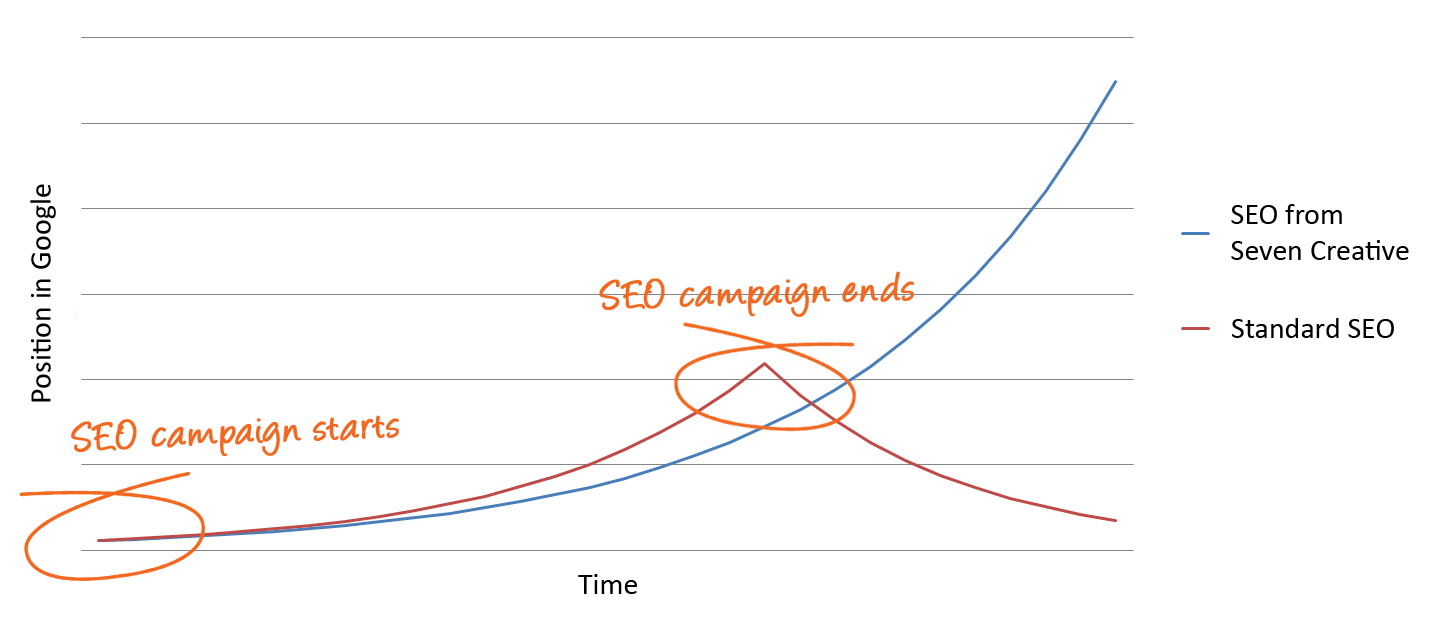
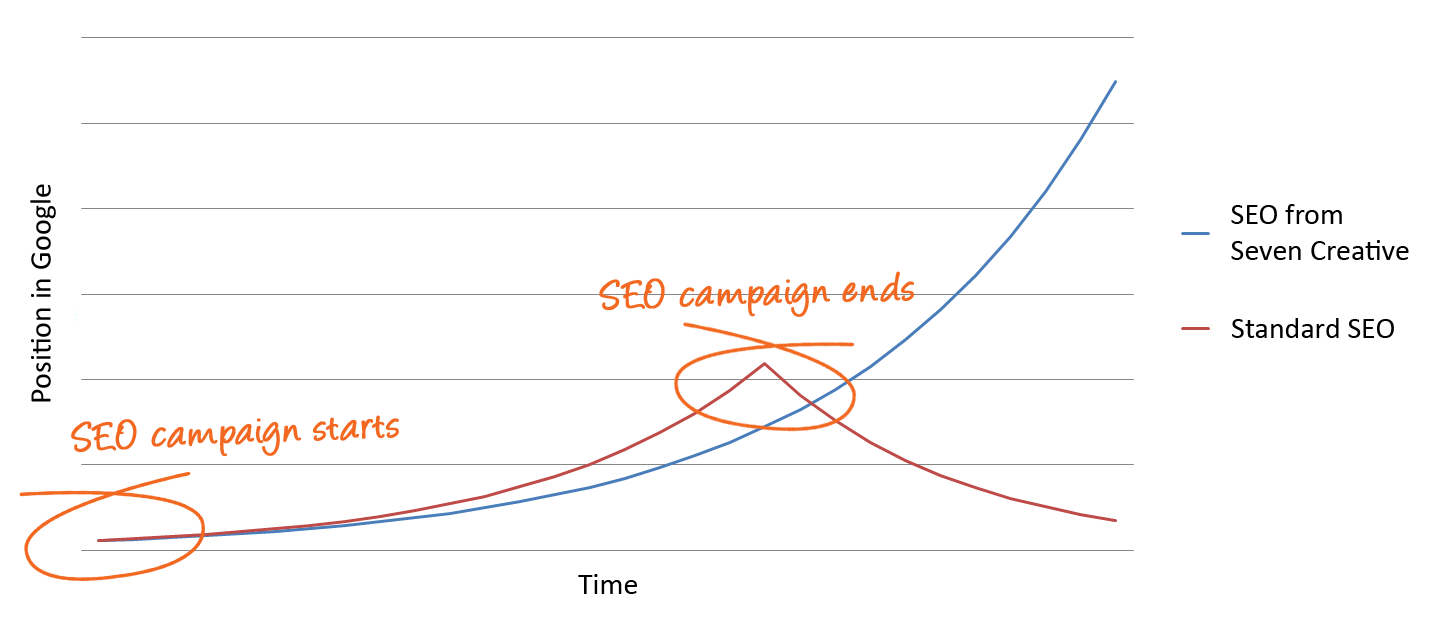
Getting your SEO right is not rocket science, it just takes a bit more care and attention. Selling someone SEO and then simply creating links to their site is either lazy or unethical (or both!). It may work for a while, however, as soon as you stop paying for this, the results will disappear again… and this is your best case scenario!!! Google is now also penalising sites that use poor quality links so, if your site is important to your business, you’re really taking a huge gamble!
This graph shows the difference between focussing your SEO on inbound links vs. focussing on good quality content and on-page SEO
I did say, however, that there was an element of truth in using link building as part of your SEO strategy, and there is. Link-building should form at least part of your SEO strategy, but you have to be very careful to make sure that the links pointing to your site are from good quality and relevant websites. Get this right and you’re on your way. Get it wrong and it can be disastrous!
The best way, however, to do your SEO properly is to do what we here at Seven Creative have always done – focus on high quality content. You’ll see not only an instant boost and an increase in rankings whilst your SEO campaign is in progress, you’ll also see a long-term boost way beyond this. This way, link-building is not something that has to be pro-actively conducted, rather it becomes something that happens organically.
We (here at Seven Creative) have always said that good quality SEO should primarily focus on ‘quality content’ & ‘on-page SEO’ – and it’s what we’ve always done. Don’t get ripped off, get it done properly.




 If you work in the field of web design and