
Category: SEO copywriting

  • 5 reasons why it might be time to update your website content

    5 reasons why it might be time to update your website content

    5 reasons why it might be time to update your website content

    How long is it since the text on your website was updated? Have you been meaning to rewrite it for ages, but it keeps getting put to the bottom of the to-do list as more urgent work presses on your time? This is a common story for many website owners, however, it might actually be a good time to get your website content updated. Here’s why:

    1. Search engines love fresh content

    Google loves lots of recently updated content. Websites that regularly add new, unique content are often seen by search engines as more important, and more relevant to web users. That means, if you keep your website up to date, you should naturally rank higher in the search engines than a site whose content remains the same, or hasn’t been updated for quite a while.

    It’s also worth checking that your website copy includes the words and phrases that you would like to be found online for. Search engine optimised copy means that your website will be more likely to be found by search engine users when they search for a product or service that you offer, meaning more visitors to your site.

    2. A news section or blog is great for SEO

    Does your website have a news section? If so, when was it last updated? Adding and regularly updating a News page is a great way of keeping your website up to date with fresh content that search engines and potential customers will love.

    There’s nothing worse than checking out a company’s news page only to find that it hasn’t been updated for 6 months. Are they not very busy? Have they gone out of business? You might not think that your company has anything to shout about, but there are lots of things you could write a short article on. For example, a new product, a new member of staff, a great testimonial, or even industry news.

    3. Visitors trust up-to-date sites

    Regular, loyal customers who see you as a reliable and trustworthy business may be fairly familiar with your site. Why not give them something new to read when they next visit? Adding fresh material to your site on a regular basis means they will keep coming back to see what’s new!

    4. Your content is out-of-date or not accurate

    So your website copy has been the same since your site went live 3 years ago. If this rings true, you need to act, and fast. Businesses naturally progress and grow, and your website needs to reflect this. The chances are, you’ve developed your services, expanded your product range or gained the experience to specialise in a particular area. And it’s not just your business that may have developed, changes in your industry are inevitable, and keeping up to date with them is key to establishing trust between you and your customers.

    5. The contents is boring or not engaging

    Even the most brilliant content can become stale over time. The attention of online readers is incredibly short, you literally have a few seconds to grab them and make them want to keep reading. Your website copy may describe exactly what you do accurately, but is it lively enough to capture the attention of a reader and to keep them there?

    Content needs to be concise and captivating, getting to the point quickly, and providing the option for readers to find out more. Text should be in bite sized sections, making it easy to scan and process the information with little effort. Text heavy paragraphs that aren’t broken up by images or bullet points are a real put off too!

    I still don’t have time to update my website content!

    Getting an agency to refresh and rewrite website contents may be more affordable than you think. We’re based in Sheffield and are very experienced in writing copy for websites. We also specialise in SEO and SEO copywriting which is a very important consideration when updating your site. If you’ve been meaning to update your website copy but never quite got round to it, we can help.

    Call Seven Creative on 0114 383 0711 or get in touch through our contact page today.
  • Search Engine Optimisation (SEO) – what is a sitemap?

    Search Engine Optimisation (SEO) – what is a sitemap?

    If you’ve ever looked into search engine optimisation (aka SEO) in any detail you’ll probably have come across what’s known as a ‘sitemap’. And if you are new to SEO, you’ll also probably be asking yourself ‘what is a sitemap’? A sitemap, in its simplest form, is a file (or files) that provide information about files and pages on your website. It normally site with your other files but it used by search engines to more easily & quickly discover the content on your site. It’s normally simply called something along the lines of ‘sitemap’ and will also normally have an ‘.XML’ extension – e.g. ‘sitemap.xml’. Sitemaps are read by search engines and this information is used to get a clearer picture of things like which pages & files there are on a website; and what type of pages & files theses are (for example, contact pages, downloads, or blog posts)

    A sitemap is designed to help your site communicate with Google and the other search engines by providing detailed information about your sites pages and contents

    What is a sitemap and why does my website need one?

    Your main website navigation is how your website visitors find their way around your website, however, these links may not always provide the whole picture to visitors. For example, there may be pages that aren’t particularly relevant to a visitor so they may not be shown these. However, the website owner may actually want all the website pages to appear in Google (as this is an important source of website traffic for many sites) so a sitemap is a fast way of letting the search engine know things such as the following:

    • Which pages & files exist on a website
    • When each page was last updated
    • How often the page is updated
    • Alternate language versions of the individual page
    • For video, how long the video is, what is the appropriate age rating, what is the video category
    • For images, what is the image of, what type of image it is, and what is the image licence

    Having a sitemaps is particularly important for:

    • Sites that contain pages or areas that are not available through the site navigation
    • Sites that use technologies such as Ajax, Silverlight, or Flash which can’t be ready easily by search engines
    • Sites that are very large meaning web crawlers may miss some of the new or recently updated content
    • Sites that have a lot of pages that are isolated or not well linked together
    • Sites that have few external links for example, new websites)

    What does a sitemap look like?

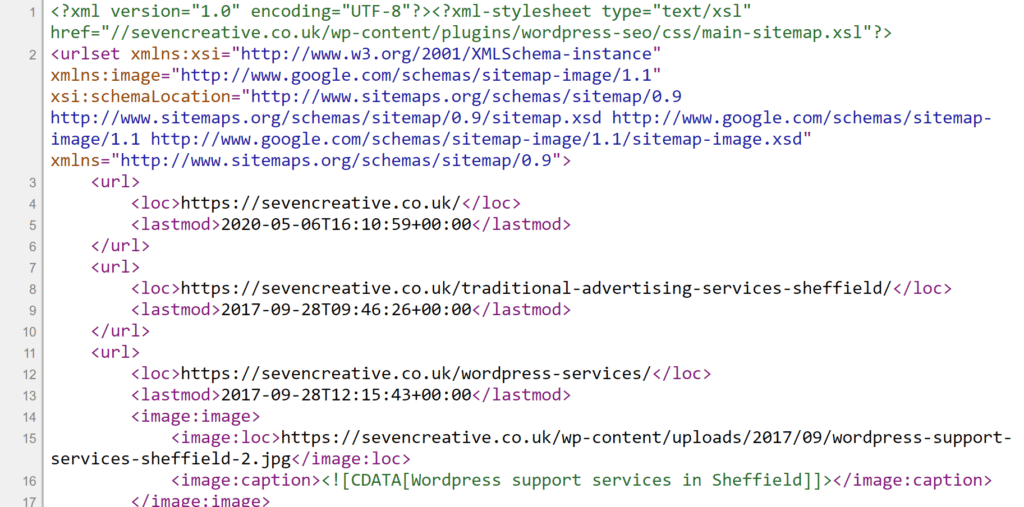
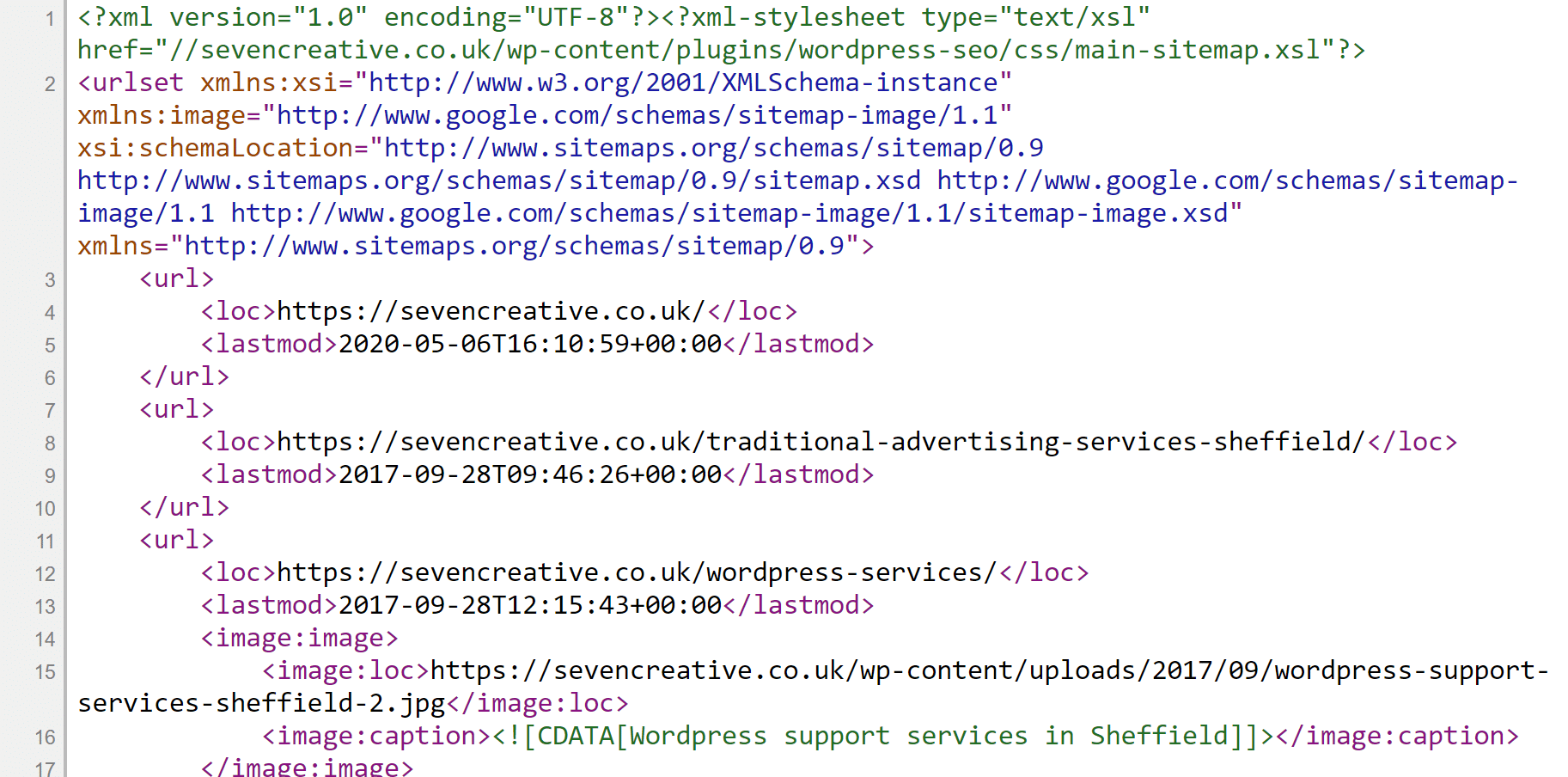
    Sitemaps for newer websites are often dynamically generated so change when new content is added. They use the XML mark-up which is like HTML but don’t have any styling information attached. Looking at the raw file may be confusing, but an XML viewer will show you the file in a more user-friendly format. Some internet browsers have an in-built XML viewer. Here is are the sitemaps for this website:

    Here is another example of a simpler sitemap:

    This particular site is quite big which hundreds of blog posts, articles, images and pages so the sitemap structure is quite big

    Website sitemaps are a very established part of a website structure (having been introduced in 2005) and continue to be important for search engine optimisation purposes. If you want your site to index properly within search engines, then making sure your sitemap is up-to-date and working correctly a very important part of your activity

    Is my website’s sitemap up-to-date?

    There are several ways to find out if your sitemap is up-to-date – some fast and some a bit more fiddly and slow. Some sites may not even have a sitemap which may be a problem from an SEO perspective. The best way to find out for certain is by asking an SEO expert to have a look.

    If you’re looking for an SEO expert or an SEO company in Sheffield for help with your website and its search engine optimisation (SEO), please give us a call on 0114 383 0711 or visit our contact section

  • What is the ‘passive voice’ and why is it important in Search Engine optimisation?

    What is the ‘passive voice’ and why is it important in Search Engine optimisation?

    If you’ve ever delved a little more deeply into search engine optimisation, you may have come across talk of the ‘passive voice’ in relation to page content. Or more specifically, why you should be avoiding using the ‘passive voice’ too much. For example, one of the most popular and widely used SEO plugins is Yoast which specifically warns against a use of the passive voice in more than 10% of the page text content. Therefore, we thought we’d take this opportunity to discuss exactly what the ‘passive voice’ is, and how to improve your page content for SEO. Don’t forget, Seven Creative is a very well established Sheffield SEO agency providing SEO services for many years. Give us a call if you would like help with your website optimisation 

    Sheffield SEO company - an article all about the passive voice

    What is the passive voice?

    “The passive voice is used to show interest in the person or object that experiences an action rather than the person or object that performs the action. In other words, the most important thing or person becomes the subject of the sentence.” – ef.co.uk

    The ‘passive voice’ is a grammatical construction which contrasts with the ‘active voice’ (the standard English sentence structure). A good way to explain this is therefore to contrast the two with examples.

    Let’s start with the subject who does something (verb) to a thing (receiver) e.g. the man (actor) throws (direct verb) a ball at the wall (receiver). In the passive voice, the actor and receiver are switched making the receiver the grammatical subject. The meaning stays the same, just the word order changes e.g. the wall had a ball thrown at it by the man. You can even omit the actor completely and say ‘the wall had a ball thrown at it’ which is still perfectly understandable but simply omits some of the information

    So why omit the passive voice?

    Well, this is an SEO article so it would be rude to not also talk about Google who are the largest and most sophisticated search engine. I say they’re a search engine put actually Google is an ad agency who sell access to us, the consumers, to the advertisers. To keep us loyal they need to provide us with the highest quality content. In other words, out of a thousand potential websites, they need to show us the best quality (and most relevant) ones first (this is page 1 of Google search results). As we humans prefer the active voice, Google therefore uses this factor in its ranking decisions (algorithm) and discriminates against sites that use the passive voice too much

    Firstly, the passive voice makes your sentence longer and wordier. Here is an excellent example from Yoast:

    1. The passive voice almost always makes your message less clear.

    2. Your message is almost always made less clear by using the passive voice.

    Secondly, using the passive voice makes your sentences more complex and require the audience to use more ‘thinking’ to understand it. Complex sentences mean more thinking which means it’s less likely you’ll get your message across

    So how do I swap to the ‘active’ voice?

    Almost every example of the passive voice has an active voice alternative so it’s simply a case of spending a little bit more time thinking about what you’ve written and re-writing those sentences that are wordy or more complex than they could be.

    When you rewrite your sentence to the active voice, not only will the verb form change, but also the actor and receiver will change places. Here are some examples:

    This blog post was written by me > I wrote this blog post (past simple)

    The website is being optimised by Seven Creative > Seven Creative are optimising the webpage (present simple continuous)

    The page will have been optimised by us > we will have optimised the page (future perfect)

    I could go on but I’m sure you get the gist!

    Are there exceptions?

    Not only is it sometimes just more logical to structure a sentence in the passive voice, but writing is an art, and you may simply prefer the passive voice.

    In other words, don’t avoid the passive voice at all costs. Rather, consider your audience in relation to your sentence and decide if the active voice may be a better alternative. However, to properly optimise your content for SEO purposes, aim for no more than about 10% use of the passive voice. Remember, in most cases, the active voice is easier to understand and that’s ultimately the aim of the game.

    A well search engine optimised website means better ranking and more leads

    Here at Seven Creative we’ve been working on SEO and optimising website for many years. If you’d like a hand with your site, give us a call on 0114 383 0711 or visit our contact section to get in touch

  • The origins of Search Engine Optimisation (SEO)

    I’ve been working with websites since before search engine optimisation (SEO) was a ‘thing’. I originally taught myself HTML as a young teenager using a book I found lying about by Carol Vordernman and the rest, as they say, for me at least, is history. I’ve been providing SEO in Sheffield & further afield now for many years. The first of the more sophisticated search engines to start ‘crawling’ the web and using ‘back-links’ to help evaluate a website was BackRub (later Google) back in 1996. It ranked pages using citation notation, meaning any mention of a website on another site would count it as a kind of vote toward the site it pointed to. In other words, basic things like how many links and the quality of those links to a site would improve its ranking and thus the search engine optimisation industry was born.

    Sheffield SEO (Search Engine optimisation)
    Sheffield SEO (Search Engine optimisation)

    It was very easy to manipulate search engines in the early days

    Back in those early halcyon days, the world wide web was not widely understood and search engines were very easy to manipulate. As businesses began to see the potential of the internet, ‘experts’ appeared who promised to get them ‘up the rankings’. It was actually very easy to do using techniques such as keyword stuffing (for example, a hundred instances of a phrase, right at the bottom of a website, in white writing and on a white background or hiding keywords in the source code) and it actually worked! This, in conjunction with very little search engine competition, created a very profitable business for many SEOs. However, this situation meant that a poor quality site could often easily rank better than a good quality sites – and Google certainly didn’t like being manipulated. Google therefore developed & improved their search algorithm to spot ‘keyword stuffed’ sites and the big change came when they released the infamous Penguin update in 2012 – overnight, many poor quality and keyword stuffed websites dropped out of the search results.

    The new Penguin rules were:

    • Show all of your content.
    • Never stuff keywords in your text or in your images’ ‘alt text’.
    • Don’t use lists of keywords to promote your content.

    If you’re interested in a bit the internet history, you click here to read the official Google Webmaster Blog post entitled ‘Another step to reward high-quality sites’ from 24th April 2012

    SEO in 2020

    Roll on to 2020, and although SEO or search engine optimisation is still a thing, it’s actually almost unrecognisable compared to what it was in those early days. Nowadays we need to focus on providing value to the audience. This, in theory anyway, means that the audience will engage with it and the ‘signals’ (such as social shares, time spent on a site, inbound links) will naturally happen. These signals are what Google use to decide where your site should rank.

    Here is a list of good SEO practice from Google’s perspective in 2020:

    • Help Google find your content
    • Tell Google which pages shouldn’t be crawled
    • Help Google (and users) understand your content
    • Manage your appearance in Google Search results
    • Organise your site hierarchy
    • Optimise your content
    • Optimise your images
    • Make your site mobile-friendly
    • ‘Promote your website’
    • Analyse your search performance and user behaviour

    I’m not going to go into detail here about exactly what these ‘guidelines’ mean as each one warrants its own 1000 word article, however, the rules basically mean that you (as a site owner) and Google (as a search engine) need to meet in the middle. Google does as much as it can to ‘understand’ your site and you need to do as much as you can to help Google ‘understood’ your site.

    However, it all becomes a lot easier to understand when you consider the following facts:

    • Google is first and foremost an advertising agency
    • In order to remain as profitable as possible, Google need to provide the best value to it’s customers (the advertisers) by providing the biggest and most relevant audience (allowing more targeted ads which improves the ROI)
    • Google’s value therefore is in the audience it provides for its advertisers
    • The audience will naturally gravitate to the best search engine experience which includes:
      • High quality
      • Relevant
      • Fast
      • Trustworthy
      • Choice

    Therefore, the better your experience, the more likely you are to use their services.

    The only company who would be potentially able to do this better that Google is Facebook. However, the reason Facebook currently can’t compete is:

    • We don’t trust them anymore. The Cambridge Analytica scandal had a lot to do with this. Their app is also far too intrusive. For example, if you have a recent Android phone, have you tried removing or even disabling the Facebook app that comes pre-installed?
    • Their results aren’t always relevant or high-quality. The content is user-generated or created by advertisers so there often simply isn’t enough choice, quality or relevance

    More importantly than that, though, is that many of us can live quite happily without Facebook but how many of us can cope without a search engine?

    Improve your search engine rankings

    Google is a fact of life but your website languishing on page 4 isn’t. You’ve seen that good search engine optimsation is no longer ‘smoke and mirrors’, rather it’s a combination of providing quality to your audience and communicating effectively with Google. Time-consuming maybe but certainly not rocket-science (or should that be ‘rocket-surgery’?) If you’d like to know where your site can be improved, give us a call on 0114 383 0711   


  • Improve Your Website’s Search Engine Rankings with These 5 SEO Tips

    As a business owner, you’re no doubt bombarded by spammy emails offering you SEO services from companies that promise they can get your website on the first page of Google. As a reputable Sheffield SEO company we know that no-one can really guarantee these results with 100% certainty. But there are certain things that you can do to help your website rank highly in the search engines, therefore increasing traffic to your website. 

    Search Engine Optimisation (SEO services) from Seven Creative
    Search Engine Optimisation (SEO services) from Seven Creative

    SEO is an abbreviation of search engine optimisation. This is the process of improving the ranking of a website in the results pages of a search engine for certain keywords in order to get more organic traffic to the site. When carried out properly, search engine optimisation provides valuable results that make a significant improvement to the amount of traffic your website receives. With that in mind, here are our top 5 SEO tips that will help to improve the ranking of your website in the search engines.

    1. Write Interesting, Engaging Content

    Interesting, engaging content has never been more important for SEO on your website or blog. Great content helps to establish you as a thought leader in your industry, and an expert in your field. Search engines prefer fresh, original content that engages users, and writing relevant content that users find interesting will not only engage users, but also build your credibility. And as you become a trusted resource for information, users will be more likely to buy your services.

    2. Share your Content on Social Media

    Another great way to boost your SEO efforts is to share your content on social media. The more your content is shared, the more links and traffic it will receive. Therefore, the more popular and relevant it seems to Google. Use Twitter, Facebook, LinkedIn, Google+ and Pinterest to promote your content, and get it shared by other users. Do your best to promote your content on relevant forums, blogs and newsletters too.

    3. Optimise Meta Data and Tags

    Optimising your titles, meta-tags, meta-descriptions and images for SEO is a must for on-page optimisation. Title tags are used on search engine results pages (SERPs) to display preview snippets for a given web page, and are important for both SEO and social sharing. Titles should be a concise and accurate description of a page’s content; getting it right is really important for both the user experience and search engine optimisation. Also, remember to use ‘Alt text’ for images, because without them, your images won’t be read by search engines, meaning that they’ll have no SEO value whatsoever.

    4. Optimise Content with Keywords

    When creating content, focus on writing great content for human readers that includes keywords and phrases to help search engines find it. But make sure that you use these keywords naturally; cramming them in where they don’t make sense or don’t read comfortably could be detrimental to your site.

    5. Use Analytics to Monitor Performance

    After all this hard work, you want to know whether or not your SEO efforts are working, right? The best way to keep track of your success is to use a tracking tool such as Google analytics to monitor the traffic coming to your website. This will enable you to pinpoint the keywords that are driving traffic, identify the pages that have had the highest numbers of visitors, and figure out which pages your customers are converting on. By keeping your eye on your analytics, you can make regular tweaks and changes to optimise your results.

    Sheffield SEO Company and Marketing Agency

    Although carrying out successful search engine optimisation takes effort, it can bring real traffic to your website. Taking these steps will certainly help you on the way to increasing the amount of web introduced business you generate. If you need some help, or would simply like to chat to an expert, Seven Creative can help. Give us a call on 0114 383 0711 or email us at info@sevencreative.co.uk to find out how we can help to grow your business with quality SEO services in Sheffield.

  • 5 Ways Google’s Hummingbird Algorithm Will Change Your SEO Copywriting

    Hummingbird – Google’s new algorithm

    In the wake of the new Google algorithm, ‘Hummingbird’, SEO copywriters have had to consider the impact of the update on the way that they write. Google isn’t interested in blindly matching keywords any more, it wants to understand what the searcher is trying to achieve so that it can deliver the most accurate results.

    google's hummingbird algorithmIf you’re not familiar with Hummingbird, here’s what Danny Sullivan from Search Engine Land said about the new algorithm:

    “Google said that Hummingbird is paying more attention to each word in a query, ensuring that the whole query — the whole sentence or conversation or meaning — is taken into account, rather than particular words. The goal is that pages matching the meaning do better, rather than pages matching just a few words.”

    Blogging for business

    If you are trying to write an article for your business blog, or wanting to revamp the text on your website, taking these 5 tips into consideration will help to improve your search rankings.

    1. Use exact-match key phrases sparingly
    2. Use individual key words
    3. Write naturally with a sprinkling of key words
    4. Only place key words and phrases where they make sense to the reader, not where you think that Google will most like to see them
    5. As well as using your chosen key phrases, incorporate synonyms into your writing

    SEO copywriter in Sheffield

    If you’re struggling to write your business blog, whether you don’t have the time or you’d like someone to take care of your SEO copywriting so you don’t have to, I can help. I have tons of experience writing SEO copy for a variety of business blogs, and can offer you an article writing package at a reasonable price. To find out more about my SEO copywriting services, call me on 0114 383 0711 

  • 5 Tips for Writing Good SEO Copy

    With Google’s recent algorithm updates, search engine optimised content is more important than ever for your website or blog. Google is putting more emphasis than ever on original, quality content. With that in mind, I’ve decided to share 5 tips that will help you get to grips with SEO copywriting.

    Man writing search engine optimised copy for his websiteWrite for Humans

    Even search engines themselves prefer natural content to copy that’s obviously for SEO purposes. Focus on creating good content for human readers, including keywords that will help search engines to find your content.

    Use Keywords Naturally

    Using relevant key words in your copy is a must. But don’t worry too much about keyword density; the important thing to do is use your keywords NATURALLY. Cramming keywords in where they don’t belong will do more harm than good!

    Title Tags and Snippets

    Your title tag is one of the first things that Google looks at when it goes about categorising a web page. Also, the title tag and the ‘snippet’ or meta description are the things that your potential customers will see in the SERPs. It’s important to include keywords within them, but to make your titles and snippets sound natural and concentrate on motivating them to click.

    Social Sharing

    The more your content is shared, the more links and traffic it will receive. Therefore, the more popular and relevant it seems to Google. Use Twitter, Facebook, LinkedIn, Google+ and Pinterest to promote your content, and get it shared by other users. Do your best to promote your content on relevant forums, blogs and newsletters too.

    Answer Questions

    People use the web every day to find answers to questions and solutions to problems. A great way to get your content found and read is to answer these questions with credible, informative content. So when people type these questions into Google, they’ll find your answer. They may even go on to visit your site. And if your answers are better than your competitors, the chances are they’ll buy from you.

    If you’re struggling with SEO copywriting and need some help, or know you should be doing it but cant find the time, I can help. My SEO copywriting service is efficient and affordable. Call me on 0114 383 0711 

  • October 2015 – Seven Creative turned 10 years old!

    October 2015 – Seven Creative turned 10 years old!

    Happy Birthday to Seven Creative
    Happy Birthday to Seven Creative

    10 years ago Seven Creative was established, and since then, we’ve helped over 300 local, national, and international business grow

    To celebrate our birthday, we’d like to tell you a little about some of the services you can use to grow your business, show you a little market insight, and give you a little something for free

    Email Marketing

    Email Marketing from Seven Creative
    Email Marketing from Seven Creative

    Email marketing continues to be, for most businesses, by far one of the most cost-effective ways of generating leads… and it’s oh, so simple!

    Not only can we provide you with a super-simple email marketing system, we can also support you with the email content, the email template, the images, and even supply you with a marketing list of targeted prospects. We can even do the whole thing for you if you’d prefer!

    Get in touch on 0114 383 0711 and let us give you a quick run through the system for free

    Mobile friendly web

    Wordpress updating and maintenance by Seven Creative
    WordPress updating and maintenance by Seven Creative

    Mobile search continues to become increasingly important following Google’s ongoing algorithm updates. Many business now reporting over 60% of their site visits come via mobile devices!

    Why not find out how mobile-friendly your site is and if it’s being penalised within the rankings by Google for poor mobile-support.

    We’ll happily do a quick site evaluation for you for free to let you know what steps need to be taken to increase mobile compatibility and what are your priorities. Give us a call today on 0114 383 0711 for more information. 

    Social Media for Business

    Social Media Management by Seven Creative
    Social Media Management by Seven Creative

    It’s here and it’s not going away, but can you afford to ignore social media? Did you know that around 64% of adults aged 50 to 64 use Facebook with 70% of them logging in daily – and they’re a lot less cynical than younger demographics.

    Also, 44% of online women use Pinterest, 28% of adults use Instagram, and 20% of the entire population use Twitter.

    How much is your CPA? I’d put money on that potentially being a whole lot cheaper with a good, solid, consistent and efficient social media strategy in place – and that’s where we can help

    Pick your channels well, create a solid strategy, and post good quality content and you can’t go wrong.

    We can coach you through the setup, show you how to use the channels effectively, and help you put together a solid social media strategy to raise your profile and generate leads

    Get in touch today on 0114 383 0711 and we’ll give you a free social media 101 to get you started

    WordPress maintenance and updating

    Wordpress updating and maintenance by Seven Creative
    WordPress updating and maintenance by Seven Creative

    WordPress is huge – accounting for over an estimated 58% of all content-managed websites online at the moment… and into 2016 this figure continues to grow!

    What many web developers don’t tell you, however, is that WordPress requires a lot of ongoing maintenance. As the biggest CMS it naturally becomes a target for hackers, but do you know if your site is safe and up-to-date?

    We’ll be able to tell you very quickly if your site is likely secure and show you steps you may need to take to secure it further.

    We’re also very experienced in developing and maintaining WordPress sites so we can also provide updates and maintenance if required. Get your free audit today

    New content and articles

    Content creation services from Seven Creative
    Content creation services from Seven Creative

    We now have to cater for a generation of internet consumers who have an increasingly short attention span due to having been bombarded with mediocre content – they expect quick fixes and instant gratification. According to a recent study by AOP, the attention span of many of your site visitors is often as short as 8 seconds it’s getting shorter!

    It’s therefore vital that you create and present fresh, concise, well written, and engaging content for your audience through all your communication channels including email marketing, your website, and social media to increase your ROI and avoid simply becoming part of the ‘noise.’

    …but you’re busy running your business and simply don’t have the time to do it. Therefore, why not let us do it for you? Get in touch for a free content strategy review including a proposal for the ongoing creation of new, fresh content.

    Anything else?

    Internet Marketing by Seven Creative
    Internet Marketing by Seven Creative

    Of course, the services listed above are just a few of things we can offer – after all we’re a full-service agency – so please don’t hesitate to get in touch if there is anything we may be able to help you with.

    From Chris and the team, thanks for being part of our first 10 years and here’s to the next 10

  • 5 Ways Great Quality Website Copywriting Can Help Your Business

    Great website copywriting can pay dividends for your business. Not only will it improve brand awareness with your potential customers; it can also help boost your visibility with the search engines.

    Whether you’re looking to update your existing content – or for brand new copy for a new website – our team of highly-skilled Sheffield copywriters are sure to be able to help. Here are a number of things great quality website copywriting can help you to do:

    Clearly Communicate the Core Values of Your Business

    SEO copywriting sheffieldPunchy website copywriting is the perfect way to communicate with your customers. When reading information published online, people want to be able to get to the point without it taking up too much of their time. The job of your website is ultimately to inform and convert your customers; and with snappy and engaging text you can do this to the best possible effect.

    New content also gives you the chance to re-evaluate the direction of your company. Refreshing the copywriting on your website can help you to assess how your goals may have changed and decide on new copy that may now be more relevant to your brand.

    Stand Out from Your Competitors

    High-end content will help you to stand out from the competitive market. Plenty of businesses are guilty of paying large sums for websites that look pretty; but are ultimately populated with content that renders that design work almost useless. You need the copy to match.

    By taking care of both the aesthetics and engagement-factor of your website, you can help to improve the experience your potential customers have whilst spending time on your site and ultimately rise to the top of the pile in your industry.

    Enhance Brand Reputation

    If you’re selling a high-end service, poor website copy can harm the reputation you’re trying to build. Poor grammar, content not written appropriately for the web and a complete lack of understanding when it comes to the needs of the customer are mistakes we commonly encounter.

    Taking the time to research exactly what it is your product or service can do to benefit your potential new clients will help you to clearly communicate the message of your brand. Once this has been decided on, the quality copywriting your website deserves can be written.

    Boost the SEO of Your Site

    Establishing yourself as an expert in your field through the copy published on your site is a great way to take responsibility for how it’s ranking. Well-written content – that is of genuine value to the industry you work within – will be incredibly well received by the Google algorithm.

    This can be taken even further with specialist SEO copywriting. By looking at the functionality of your website content with relation to keyword density and heading tags; copywriting specifically written for SEO purposes can drive more genuine traffic to your site. When done well, it can give your site the extra push it needs to work its way up the rankings.

    Increase Site Traffic and Convert More Customers

    Ultimately, content written by a great copywriter will entice more people to your website and help persuade them to buy your product or service. The higher quality the copy on your site, the more likely it is that your audience will engage with it for longer and convert. Get the message and tone right and you can look forward to further online growth.

    Speak to a Copywriter from Our Sheffield Marketing Agency Today

    The value attached to optimised website content is significant. For many, it’s just a case of getting round to its creation. Our Sheffield copywriters are highly experienced in the production of everything from SEO copywriting to site content re-writes; so please don’t hesitate to contact us at Seven Creative today. You can reach us by calling 0114 383 0711.


  • 5 Top Tips on Writing for Web

    Understanding how internet users read online text is half the battle of writing great web content.

    The truth is, people don’t really web content word for word, the way you would a beautifully written novel for example.

    They prefer to pick out key words and sentences to get an overall understanding of the content. This means that web copy needs to be scannable.

    So, here are my 5 top tips for writing for the web!

    copy-writing-for-web

    1. Use Sub -headings

    Sub-headings are a great way of breaking up the text into bite size chunks. They make it easy for readers to scan over the page, and digest the information without being swamped in text heavy web pages.

    2. Highlight Keywords

    Highlighting a keyword in bold or adding a hyperlink again makes the information easier to scan and digest. Readers are naturally drawn to the highlighted words and phrases, which should be integral to the understanding of the article.

    3. One Idea per Paragraph

    Keep paragraphs short, and as a rule, only include one key idea in each paragraph. Again, this will help readers to absorb the information easily and maintain the structure of your article. Generally, if readers are not captured by the first sentence, they will tend to skip the rest of the paragraph and move on to the next one.

    4. Word Count

    Opinions differ on the correct length of an online article or blog post. My personal preference is around 400 words, and never more than 600. This might not sound like a lot, but if you consider the attention span of readers and their preference for bite sized chunks of information, you can actually fit a fair few ideas into an article of this length. Which brings me my next point..

    5. Use Bullet Points

    Bulleted lists are easy to read, quick to scan, and can deliver a great deal of information in just a few lines. Perfect of web users!

    If you have written a blog post or article, and need a hand editing or proofreading to make sure it’s perfect for the web, I can help. Whether you need content written from scratch, or you would like an expert to check through your grammar, punctuation and style, call Content Writer Extraordinaire on 0114 383 0711.

    For our full range of Sheffield copy writing services, please visit Seven Creative’s website at sevencreative.co.uk, the leading marketing agency in Sheffield.